Ch. 7 - Estimating Parameters and Determining Sample Sizes
Triola - Elementary Statistics 14th Edition
Triola14th EditionElementary StatisticsISBN: 9780137366446Not the one you use?Change textbook
Chapter 7, Problem 7.1.34b

Astrology A sociologist plans to conduct a survey to estimate the percentage of adults who believe in astrology. How many people must be surveyed if we want a confidence level of 99% and a margin of error of four percentage points?


b. Use the information from a previous Harris survey in which 26% of respondents said that they believed in astrology.

Verified step by step guidance
1
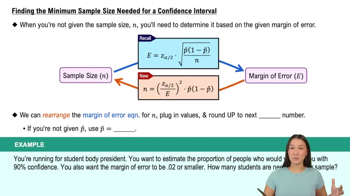
Determine the formula for the required sample size when estimating a population proportion. The formula is: n=(z)2(p(1-p))/E2, where z is the z-score corresponding to the confidence level, p is the estimated proportion, and E is the margin of error.
Identify the values given in the problem: the confidence level is 99%, so the z-score corresponding to this level is approximately 2.576. The margin of error is 4%, or 0.04. From the previous survey, the estimated proportion p is 0.26.
Substitute the values into the formula: n=(2.576)2(0.26(1-0.26))/0.042.
Simplify the expression step by step: First, calculate 1-0.26, then multiply 0.26 by the result. Next, square the z-score 2.576, and multiply it by the product of 0.26(1-0.26). Finally, divide by the square of the margin of error 0.04.
Round the result to the nearest whole number, as the sample size must be a whole number. This will give you the minimum number of people that must be surveyed to achieve the desired confidence level and margin of error.

Verified video answer for a similar problem:

This video solution was recommended by our tutors as helpful for the problem above.
Video duration:
2m
Was this helpful?

Key Concepts

Here are the essential concepts you must grasp in order to answer the question correctly.

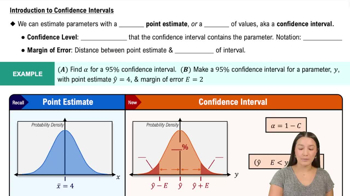
Confidence Level

The confidence level represents the degree of certainty that the true population parameter lies within the confidence interval. A 99% confidence level means that if the survey were repeated multiple times, 99% of the calculated intervals would contain the true percentage of adults who believe in astrology. This high level of confidence typically requires a larger sample size.
Recommended video:
06:33
Introduction to Confidence Intervals

Margin of Error

The margin of error indicates the range within which the true population parameter is expected to fall, based on the sample results. In this case, a margin of error of four percentage points means that if the survey estimates that 26% of adults believe in astrology, the actual percentage is likely between 22% and 30%. A smaller margin of error requires a larger sample size.
Recommended video:
04:08
Finding the Minimum Sample Size Needed for a Confidence Interval

Sample Size Calculation

Sample size calculation is a statistical method used to determine the number of respondents needed to achieve a desired level of confidence and margin of error. It involves using the estimated proportion (in this case, 26%) along with the desired confidence level and margin of error to ensure that the survey results are statistically valid and reliable.
Recommended video:
05:11
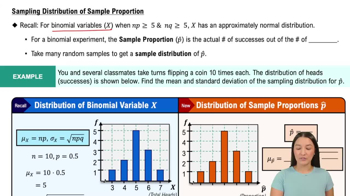
Sampling Distribution of Sample Proportion
Related Practice
Textbook Question

Critical Thinking. In Exercises 17–28, use the data and confidence level to construct a confidence interval estimate of p, then address the given question.


OxyContin The drug OxyContin (oxycodone) is used to treat pain, but it is dangerous because it is addictive and can be lethal. In clinical trials, 227 subjects were treated with OxyContin and 52 of them developed nausea (based on data from Purdue Pharma L.P.).


b. Compare the result from part (a) to this 95% confidence interval for 5 subjects who developed nausea among the 45 subjects given a placebo instead of OxyContin: . What do you conclude?

203
views
Textbook Question

Alcohol in Children’s Movies Listed below is a simple random sample of times (seconds) that animated children’s movies showed the use of alcohol (based on Data Set 20 “Alcohol and Tobacco in Movies” in Appendix B).


b. Are the requirements for constructing a 95% confidence interval estimate of the population standard deviation satisfied? If so, construct that confidence interval.


106
views
Textbook Question

Mean Pulse Rate of Males Data Set 1 “Body Data” in Appendix B includes pulse rates of 153 randomly selected adult males, and those pulse rates vary from a low of 40 bpm to a high of 104 bpm. Find the minimum sample size required to estimate the mean pulse rate of adult males. Assume that we want 99% confidence that the sample mean is within 2 bpm of the population mean.


b. Assume that sigma=11.3 bpm, based on the value of s=11.3 bpm for the sample of 153 male pulse rates.


110
views
Textbook Question

Critical Thinking. In Exercises 17–28, use the data and confidence level to construct a confidence interval estimate of p, then address the given question.


Tennis Challenges In a recent U. S. Open tennis tournament, women playing singles matches used challenges on 137 calls made by the line judges. Among those challenges, 33 were found to be successful with the call overturned.


b. Compare the result from part (a) to this 99% confidence interval for the percentage of successful challenges made by the men playing singles matches: . Does it appear that either gender is more successful than the other?

87
views
Textbook Question

Touch Your Nose With Your Tongue Find the sample size needed to estimate the percentage of adults who can touch their nose with their tongue. Use a margin of error of 2 percentage points and use a confidence level of 90%.


b. Assume that a previous study showed that 10% of adults can touch their nose with their tongue (based on data from Onedio).


121
views
Textbook Question

Critical Thinking. In Exercises 17–28, use the data and confidence level to construct a confidence interval estimate of p, then address the given question.


Job Interviews In a Harris poll of 514 human resource professionals, 45.9% said that body piercings and tattoos were big personal grooming red flags.


c. Repeat part (b) using a confidence level of 80%.


125
views