
Ch. 7 - Estimating Parameters and Determining Sample Sizes
Triola - Elementary Statistics 14th Edition
Triola14th EditionElementary StatisticsISBN: 9780137366446Not the one you use?Change textbook
Chapter 7, Problem 7.3.10

Atkins Weight Loss Program In a test of weight loss programs, 40 adults used the Atkins weight loss program. After 12 months, their mean weight loss was found to be 2.1 lb, with a standard deviation of 4.8 lb. Construct a 90% confidence interval estimate of the standard deviation of the weight loss for all such subjects. Does the confidence interval give us information about the effectiveness of the diet?

Verified step by step guidance
1
Step 1: Recognize that the problem involves constructing a confidence interval for the population standard deviation. The sample standard deviation (s) is given as 4.8 lb, and the sample size (n) is 40. The confidence level is 90%.
Step 2: Use the Chi-Square distribution to construct the confidence interval for the population standard deviation. The formula for the confidence interval of the population variance (σ²) is: \( \left( \frac{(n-1)s^2}{\chi^2_{\text{upper}}}, \frac{(n-1)s^2}{\chi^2_{\text{lower}}} \right) \), where \( \chi^2_{\text{upper}} \) and \( \chi^2_{\text{lower}} \) are the critical values of the Chi-Square distribution for the given confidence level.
Step 3: Calculate the degrees of freedom (df), which is \( n-1 \). For this problem, \( df = 40 - 1 = 39 \). Use a Chi-Square table or statistical software to find the critical values \( \chi^2_{\text{upper}} \) and \( \chi^2_{\text{lower}} \) for a 90% confidence level with 39 degrees of freedom.
Step 4: Substitute the values into the formula for the confidence interval of the variance. Then, take the square root of the lower and upper bounds of the variance confidence interval to obtain the confidence interval for the standard deviation.
Step 5: Interpret the confidence interval. The interval provides a range of plausible values for the population standard deviation of weight loss. However, it does not directly provide information about the effectiveness of the diet, as effectiveness would require comparing the mean weight loss to a meaningful benchmark or control group.

Verified video answer for a similar problem:

This video solution was recommended by our tutors as helpful for the problem above.
Video duration:
4m
Was this helpful?

Key Concepts

Here are the essential concepts you must grasp in order to answer the question correctly.

Confidence Interval

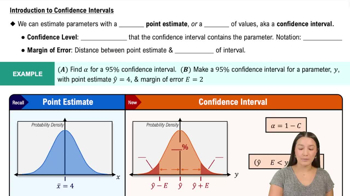
A confidence interval is a range of values, derived from sample statistics, that is likely to contain the true population parameter with a specified level of confidence. For example, a 90% confidence interval suggests that if we were to take many samples and construct intervals in the same way, approximately 90% of those intervals would contain the true standard deviation of the population.
Recommended video:
06:33
Introduction to Confidence Intervals

Standard Deviation

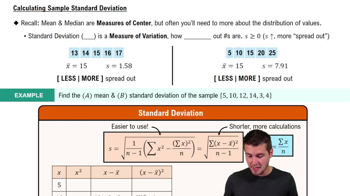
Standard deviation is a measure of the amount of variation or dispersion in a set of values. In the context of weight loss, a higher standard deviation indicates that the weight loss among participants varied widely, while a lower standard deviation suggests that the weight loss was more consistent across individuals. Understanding this helps in interpreting the effectiveness of the weight loss program.
Recommended video:
Guided course
08:45
Calculating Standard Deviation

Effectiveness of a Diet

The effectiveness of a diet refers to its ability to produce desired weight loss results among participants. While a confidence interval can provide insights into the variability of weight loss, it does not directly indicate effectiveness. To assess effectiveness, one must consider both the mean weight loss and the context of the results, including how they compare to other diets or health standards.
Recommended video:
Guided course
05:48
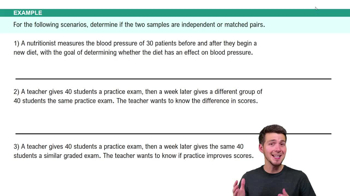
Introduction to Matched Pairs Example 1
Related Practice
Textbook Question

Ages of Moviegoers Find the sample size needed to estimate the mean age of movie patrons, given that we want 98% confidence that the sample mean is within 1.5 years of the population mean. Assume that sigma=19.6 years, based on a previous report from the Motion Picture Association of America. Could the sample be obtained from one movie at one theater?

121
views
Textbook Question

Mean Assume that we want to use the sample data given in Exercise 1 with the bootstrap method to estimate the population mean. The mean of the values in Exercise 1 is 54.3 seconds, and the mean of all of the tobacco times in Data Set 20 “Alcohol and Tobacco in Movies” from Appendix B is 57.4 seconds. If we use 1000 bootstrap samples and find the corresponding 1000 means, do we expect that those 1000 means will target 54.3 seconds or 57.4 seconds? What does that result suggest about the bootstrap method in this case?

123
views
Textbook Question

One-Sided Confidence Interval A one-sided claim about a population proportion is a claim that the proportion is less than (or greater than) some specific value. Such a claim can be formally addressed using a one-sided confidence interval for p, which can be expressed as p<p+E or p>p-E, where the margin of error E is modified by replacing za/2 with za. (Instead of dividing between two tails of the standard normal distribution, put all of it in one tail.) The Chapter Problem refers to a Sallie Mae survey of 950 undergraduate students, and 53% of the survey subjects take online courses. Use that data to construct a one-sided 95% confidence interval that would be suitable for helping to determine whether the percentage of all undergraduates who take online courses is greater than 50%.

313
views
Textbook Question

Critical Thinking. In Exercises 17–28, use the data and confidence level to construct a confidence interval estimate of p, then address the given question.


Measured Results vs. Reported Results The same study cited in the preceding exercise produced these results after six months for the 198 patients given sustained care: 25.8% were no longer smoking, and these results were biochemically confirmed, but 40.9% of these patients reported that they were no longer smoking. Construct the two 95% confidence intervals. Compare the results. What do you conclude?

117
views
Textbook Question

"Critical Thinking. In Exercises 17–28, use the data and confidence level to construct a confidence interval estimate of p, then address the given question.


Internet Use A random sample of 5005 adults in the United States includes 751 who do not use the Internet (based on three Pew Research Center polls). Construct a 95% confidence interval estimate of the percentage of U.S. adults who do not use the Internet. Based on the result, does it appear that the percentage of U.S. adults who do not use the Internet is different from 48%, which was the percentage in the year 2000?"

175
views
Textbook Question

Use the given information to find the number of degrees of freedom, the critical values X2L and X2R, and the confidence interval estimate of σ. It is reasonable to assume that a simple random sample has been selected from a population with a normal distribution:


Nicotine in Menthol Cigarettes 95% confidence; n = 25, s = 0.24 mg

149
views