
Ch. 7 - Estimating Parameters and Determining Sample Sizes
Triola - Elementary Statistics 14th Edition
Triola14th EditionElementary StatisticsISBN: 9780137366446Not the one you use?Change textbook
Chapter 7, Problem 7.CR.8c

Controversial Song The song “Baby It’s Cold Outside” generated much controversy because of its lyrics and tone. CBS New York conducted a survey by asking viewers to use the Internet to respond to a question asking whether that song was really too offensive to play. Among 1043 Internet users who chose to respond, 986 said that the song was not too offensive, and 57 of the respondents said that the song was too offensive.
.
c. What is wrong with this survey? Based on this survey, what do we really know about the population?

Verified step by step guidance
1
Step 1: Understand the concept of sampling bias. Sampling bias occurs when the sample collected is not representative of the population being studied. In this case, the survey was conducted using Internet users who chose to respond voluntarily, which introduces self-selection bias.
Step 2: Analyze the method of data collection. Since the survey relied on voluntary responses, it is likely that individuals with strong opinions (either for or against the song) were more motivated to participate, skewing the results.
Step 3: Consider the population being studied. The survey results reflect the opinions of 1043 Internet users who chose to respond, but this group may not represent the general population's views. For example, people without Internet access or those who did not see the survey were excluded.
Step 4: Evaluate the reliability of the survey. Because of the self-selection bias and the limited scope of respondents, the survey cannot reliably provide insights into the opinions of the entire population. It only reflects the views of the specific group of respondents.
Step 5: Conclude what can be inferred. Based on this survey, we can only infer the opinions of the 1043 Internet users who responded, not the opinions of the general population. The survey results are not generalizable due to the sampling method and potential biases.

Verified video answer for a similar problem:

This video solution was recommended by our tutors as helpful for the problem above.
Video duration:
6m
Was this helpful?

Key Concepts

Here are the essential concepts you must grasp in order to answer the question correctly.

Sampling Bias

Sampling bias occurs when the sample selected for a survey does not accurately represent the larger population. In this case, the survey was conducted among Internet users who chose to respond, which may not reflect the views of all individuals regarding the song. This can lead to skewed results and conclusions that do not apply to the general population.
Recommended video:
05:11
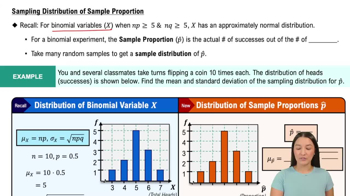
Sampling Distribution of Sample Proportion

Response Rate

The response rate is the percentage of people who participate in a survey compared to the total number of individuals surveyed. A low response rate can indicate that the results may not be reliable or representative. In this scenario, we do not know how many people were asked to participate versus how many actually responded, which raises questions about the validity of the findings.
Recommended video:
06:10
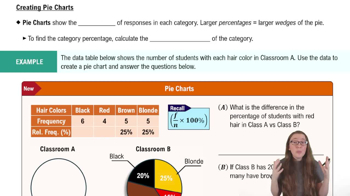
Creating Pie Charts

Population vs. Sample

In statistics, the population refers to the entire group of individuals or instances about which we want to draw conclusions, while a sample is a subset of that population. The survey results only reflect the opinions of the 1,043 respondents, not the broader population's views on the song. Therefore, we cannot generalize the findings to all individuals, as the sample may not be representative.
Recommended video:
05:11
Sampling Distribution of Sample Proportion
Related Practice
Textbook Question

Cell Phone Radiation. Listed below are amounts of cell phone radiation (W/kg) measured from randomly selected cell phones (based on data from the Federal Communications Commission). Use these values for Exercises 1–6.


[Image]


Level of Measurement What is the level of measurement of these data (nominal, ordinal, interval, ratio)? Are the original unrounded amounts of radiation continuous data or discrete data?

248
views
Textbook Question

Controversial Song The song “Baby It’s Cold Outside” generated much controversy because of its lyrics and tone. CBS New York conducted a survey by asking viewers to use the Internet to respond to a question asking whether that song was really too offensive to play. Among 1043 Internet users who chose to respond, 986 said that the song was not too offensive, and 57 of the respondents said that the song was too offensive.


b. Based on the result from part (a), is it safe to say that the majority of the population does not feel that the song is too offensive.


116
views
Textbook Question

Distributions Identify the distribution (normal, Student t, chi-square) that should be used in each of the following situations. If none of the three distributions can be used, what other method could be used?


a. In constructing a confidence interval of , you have 75 sample values and they appear to be from a population with a skewed distribution. The population standard deviation is not known.


188
views
Textbook Question

Arm Circumferences Listed below are arm circumferences (cm) of randomly selected women (based on Data Set 1 “Body Data” from Appendix B). Also shown is the normal quantile plot of those measurements.


b. Are the requirements for constructing a 95% confidence interval estimate of the population standard deviation satisfied? If so, construct that confidence interval.

86
views
Textbook Question

Requirements A construction quality control analyst has collected a random sample of six concrete road barriers, and she plans to weigh each of them and construct a 95% confidence interval estimate of the mean weight of all such barriers. What requirements must be satisfied in order to construct the confidence interval with the method from Section 7-2 that uses the t distribution?

102
views
Textbook Question

Degrees of Freedom In general, what does “degrees of freedom” refer to? For the sample data described in Exercise 7 “Requirements,” find the number of degrees of freedom, assuming that you want to construct a confidence interval estimate of u using the t distribution.

166
views