
Ch. 7 - Estimating Parameters and Determining Sample Sizes
Triola - Elementary Statistics 14th Edition
Triola14th EditionElementary StatisticsISBN: 9780137366446Not the one you use?Change textbook
Chapter 7, Problem 7.1.19a

Critical Thinking. In Exercises 17–28, use the data and confidence level to construct a confidence interval estimate of p, then address the given question.


Tennis Challenges In a recent U. S. Open tennis tournament, women playing singles matches used challenges on 137 calls made by the line judges. Among those challenges, 33 were found to be successful with the call overturned.


a. Construct a 99% confidence interval for the percentage of successful challenges.

Verified step by step guidance
1
Step 1: Identify the given data and parameters. The number of challenges is 137, and the number of successful challenges is 33. The confidence level is 99%, which corresponds to a significance level (α) of 0.01.
Step 2: Calculate the sample proportion (p̂) of successful challenges. The formula for the sample proportion is p̂ = x / n, where x is the number of successes (33) and n is the total number of trials (137).
Step 3: Determine the critical value (z*) for a 99% confidence level. Use a standard normal distribution table or calculator to find the z* value corresponding to a 99% confidence level. For a two-tailed test, z* is approximately 2.576.
Step 4: Calculate the standard error (SE) of the sample proportion. The formula for the standard error is SE = sqrt((p̂ * (1 - p̂)) / n), where p̂ is the sample proportion and n is the sample size.
Step 5: Construct the confidence interval for the population proportion (p). The formula for the confidence interval is p̂ ± z* × SE. Substitute the values of p̂, z*, and SE into the formula to compute the lower and upper bounds of the confidence interval.

Verified video answer for a similar problem:

This video solution was recommended by our tutors as helpful for the problem above.
Video duration:
3m
Was this helpful?

Key Concepts

Here are the essential concepts you must grasp in order to answer the question correctly.

Confidence Interval

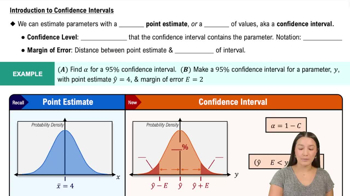
A confidence interval is a range of values, derived from sample statistics, that is likely to contain the true population parameter with a specified level of confidence. For example, a 99% confidence interval suggests that if we were to take many samples and construct intervals in the same way, approximately 99% of those intervals would contain the true proportion of successful challenges.
Recommended video:
06:33
Introduction to Confidence Intervals

Proportion

In statistics, a proportion is a type of ratio that represents the part of a whole. In this context, it refers to the ratio of successful challenges to the total number of challenges made. The sample proportion can be calculated by dividing the number of successful challenges (33) by the total challenges (137), which is essential for constructing the confidence interval.
Recommended video:
Guided course
09:27
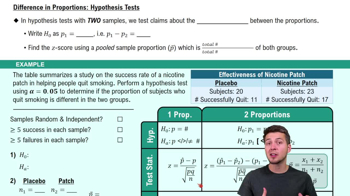
Difference in Proportions: Hypothesis Tests

Margin of Error

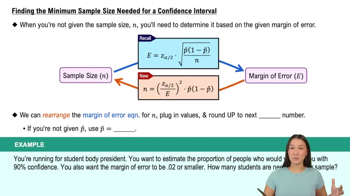
The margin of error quantifies the uncertainty associated with a sample estimate. It is calculated using the standard error of the sample proportion and a critical value from the Z-distribution corresponding to the desired confidence level. For a 99% confidence interval, the margin of error helps determine how far the sample proportion may deviate from the true population proportion, thus defining the width of the confidence interval.
Recommended video:
04:08
Finding the Minimum Sample Size Needed for a Confidence Interval
Related Practice
Textbook Question

Analysis of Last Digits Weights of respondents were recorded as part of the California Health Interview Survey. The last digits of weights from 50 randomly selected respondents are listed below.


a. Use the bootstrap method with 1000 bootstrap samples to find a 95% confidence interval estimate of .

122
views
Textbook Question

Comparing Waiting Lines


The values listed below are waiting times (in minutes) of customers at the Jefferson Valley Bank, where customers enter a single waiting line that feeds three teller windows. Construct a 95% confidence interval for the population standard deviation sigma.

131
views
Textbook Question

Cell Phone Radiation Here is a sample of measured radiation emissions (cW/kg) for cell phones (based on data from the Environmental Working Group): 38, 55, 86, 145. Here are ten bootstrap samples:

[Image]


a. Using only the ten given bootstrap samples, construct an 80% confidence interval estimate of the population mean.


107
views
Textbook Question

Freshman 15 Here is a sample of amounts of weight change (kg) of college students in their freshman year (from Data Set 13 “Freshman 15” in Appendix B): 11, 3, 0, , where represents a loss of 2 kg and positive values represent weight gained. Here are ten bootstrap samples:

[Image]


a. Using only the ten given bootstrap samples, construct an 80% confidence interval estimate of the mean weight change for the population.


159
views
Textbook Question

Critical Thinking. In Exercises 17–28, use the data and confidence level to construct a confidence interval estimate of p, then address the given question.


Job Interviews In a Harris poll of 514 human resource professionals, 90% said that the appearance of a job applicant is most important for a good first impression.


a. Among the 514 human resource professionals who were surveyed, how many of them said that the appearance of a job applicant is most important for a good first impression?


122
views
Textbook Question

Archeology Archeologists have studied sizes of Egyptian skulls in an attempt to determine whether breeding occurred between different cultures. Listed below are the widths (mm) of skulls from 150 A.D. (based on data from Ancient Races of the Thebaid by Thomson and Randall-Maciver).


a. Use 1000 bootstrap samples to construct a 99% confidence interval estimate of the mean skull width.


95
views