
Ch. 7 - Estimating Parameters and Determining Sample Sizes
Triola - Elementary Statistics 14th Edition
Triola14th EditionElementary StatisticsISBN: 9780137366446Not the one you use?Change textbook
Chapter 7, Problem 1a

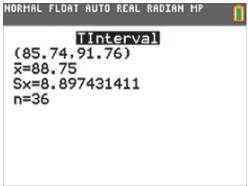
In Exercises 1–4, refer to the accompanying screen display that results from a simple random sample of times (minutes) between eruptions of the Old Faithful geyser. The confidence level of 95% was used.
calc
Refer to the accompanying screen display.


a. Express the confidence interval in the format that uses the “less than” symbol. Round the confidence interval limits given that the original times are all rounded to one decimal place.

Verified step by step guidance
1
Identify the confidence interval limits from the screen display. The confidence interval is given as (85.74, 91.76).
Express the confidence interval in the format using the 'less than' symbol. This means rewriting it as: 85.74 < μ < 91.76, where μ represents the population mean.
Round the confidence interval limits to one decimal place, as specified in the problem. In this case, the limits are already rounded to one decimal place: 85.7 and 91.8.
Rewrite the rounded confidence interval in the 'less than' format: 85.7 < μ < 91.8.
Verify that the format and rounding are consistent with the problem's requirements, ensuring clarity and correctness in the final expression.

Verified video answer for a similar problem:

This video solution was recommended by our tutors as helpful for the problem above.
Video duration:
2m
Was this helpful?

Key Concepts

Here are the essential concepts you must grasp in order to answer the question correctly.

Confidence Interval

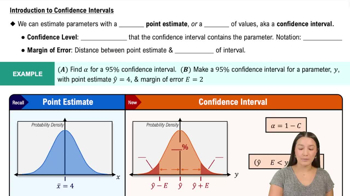
A confidence interval is a range of values, derived from sample statistics, that is likely to contain the true population parameter. It is expressed with an upper and lower limit, indicating the degree of uncertainty around the estimate. For example, a 95% confidence interval suggests that if we were to take many samples, approximately 95% of the intervals calculated would contain the true mean.
Recommended video:
06:33
Introduction to Confidence Intervals

Sample Mean (x̄)

The sample mean, denoted as x̄, is the average of a set of observations from a sample. It serves as a point estimate of the population mean. In the context of the Old Faithful geyser data, the sample mean of 88.75 minutes represents the average time between eruptions based on the sampled data.
Recommended video:
05:11
Sampling Distribution of Sample Proportion

Sample Size (n)

The sample size, represented by n, is the number of observations in a sample. It is crucial for determining the reliability of statistical estimates; larger sample sizes generally lead to more accurate estimates of population parameters. In this case, n=36 indicates that the sample consists of 36 eruption times, which contributes to the calculation of the confidence interval.
Recommended video:
05:11
Sampling Distribution of Sample Proportion