Ch. 9 - Inferences from Two Samples
Triola - Elementary Statistics 14th Edition
Triola14th EditionElementary StatisticsISBN: 9780137366446Not the one you use?Change textbook
Chapter 9, Problem 9.2.26

Degrees of Freedom In Exercise 20 “Blanking Out on Tests,” using the “smaller of n1-1 and n2-1” for the number of degrees of freedom results in df=15 Find the number of degrees of freedom using Formula 9-1. In general, how are hypothesis tests and confidence intervals affected by using Formula 9-1 instead of the “smaller of n1-1 and n2-1 ”?

Verified step by step guidance
1
Step 1: Recall the formula for degrees of freedom (df) using Formula 9-1. The formula is: df = s 1 4 / n 1 + s 2 4 / n 2 s 1 2 / n 1 + s 2 2 / n 2 , where s1 and s2 are the sample standard deviations, and n1 and n2 are the sample sizes.
Step 2: Identify the values of s1, s2, n1, and n2 from the problem or data provided. If these values are not explicitly given, they must be determined or assumed based on the context of the problem.
Step 3: Substitute the identified values of s1, s2, n1, and n2 into Formula 9-1. Perform the necessary calculations for the numerator and denominator separately to simplify the expression for df.
Step 4: Compare the degrees of freedom obtained using Formula 9-1 with the 'smaller of n1-1 and n2-1' method. Note that Formula 9-1 typically provides a more precise (and often smaller) value for df, which can affect the critical values used in hypothesis tests and confidence intervals.
Step 5: Explain the impact of using Formula 9-1. Using Formula 9-1 generally results in a more accurate representation of the degrees of freedom, which can lead to slightly wider confidence intervals and more conservative hypothesis tests compared to using the simpler 'smaller of n1-1 and n2-1' method.

Verified video answer for a similar problem:

This video solution was recommended by our tutors as helpful for the problem above.
Video duration:
5m
Was this helpful?

Key Concepts

Here are the essential concepts you must grasp in order to answer the question correctly.

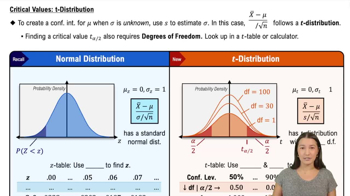
Degrees of Freedom

Degrees of freedom (df) refer to the number of independent values or quantities that can vary in an analysis without violating any constraints. In hypothesis testing, df is crucial for determining the appropriate distribution to use, which affects the critical values and p-values. For two samples, the degrees of freedom can be calculated using different methods, impacting the results of statistical tests.
Recommended video:
05:50
Critical Values: t-Distribution

Hypothesis Testing

Hypothesis testing is a statistical method used to make inferences about population parameters based on sample data. It involves formulating a null hypothesis and an alternative hypothesis, then using sample data to determine whether to reject the null hypothesis. The choice of degrees of freedom influences the test's power and the likelihood of making Type I or Type II errors.
Recommended video:
Guided course
06:21
Step 1: Write Hypotheses

Confidence Intervals

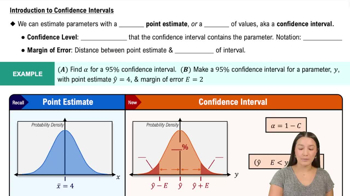
A confidence interval is a range of values, derived from sample statistics, that is likely to contain the true population parameter with a specified level of confidence. The width of the confidence interval is affected by the sample size and the degrees of freedom used in its calculation. Using different methods for calculating degrees of freedom can lead to narrower or wider intervals, thus impacting the precision of the estimates.
Recommended video:
06:33
Introduction to Confidence Intervals
Related Practice
Textbook Question

Body Temperatures Listed below are body temperatures from six different subjects measured at two different times in a day (from Data Set 5 “Body Temperatures” in Appendix B).


a. Are the two sets of data independent or dependent? Explain.


[Image]

377
views
Textbook Question

Randomization vs t Test Two samples of commute times from Boston and New York are randomly selected and it is found that the samples sizes are n1 = 18 and n2 = 12 and each of the two samples appears to be from a population with a distribution that is dramatically far from normal. Which method is more likely to yield better results for testing Mu1 is not equals to Mu2. Hypothesis test using the t distribution (as in Section 9-2) or the resampling method?

101
views
Textbook Question

Robust What does it mean when we say that the F test described in this section is not robust against departures from normality?

227
views
Textbook Question

No Variation in a Sample An experiment was conducted to test the effects of alcohol. Researchers measured the breath alcohol levels for a treatment group of people who drank ethanol and another group given a placebo. The results are given below (based on data from “Effects of Alcohol Intoxication on Risk Taking, Strategy, and Error Rate in Visuomotor Performance,” by Streufert et al., Journal of Applied Psychology, Vol. 77, No. 4). Use a 0.05 significance level to test the claim that the two sample groups come from populations with the same mean.


142
views
Textbook Question

Degrees of Freedom For Example 1, we used df=smaller of n1-1 and n2-1 we got df=11 and the corresponding critical value is t=-1.796 (found from Table A-4). If we calculate df using Formula 9-1, we get df=19.370 and the corresponding critical value is t=-1.727 How is using the critical value of t=-1.796 “more conservative” than using the critical value of t=-1.727

241
views
Textbook Question

Is Friday the 13th Unlucky? Listed below are numbers of hospital admissions in one region due to traffic accidents on different Fridays falling on the 6th day of a month and the following 13th day of the month (based on data from “Is Friday the 13th Bad for Your Health,” by Scanlon et al., British Medical Journal, Vol. 307). Assume that we want to use a 0.05 significance level to test the claim that the data support the claim that fewer hospital admissions due to traffic accidents occur on Friday the 6th than on the following Friday the 13th. Identify the null hypothesis and alternative hypothesis.


132
views