
Ch. 9 - Inferences from Two Samples
Triola - Elementary Statistics 14th Edition
Triola14th EditionElementary StatisticsISBN: 9780137366446Not the one you use?Change textbook
Chapter 9, Problem 10c

Denomination Effect A trial was conducted with 75 women in China given a 100-yuan bill, while another 75 women in China were given 100 yuan in the form of smaller bills (a 50-yuan bill plus two 20-yuan bills plus two 5-yuan bills). Among those given the single bill, 60 spent some or all of the money. Among those given the smaller bills, 68 spent some or all of the money (based on data from “The Denomination Effect,” by Raghubir and Srivastava, Journal of Consumer Research, Vol. 36). We want to use a 0.05 significance level to test the claim that when given a single large bill, a smaller proportion of women in China spend some or all of the money when compared to the proportion of women in China given the same amount in smaller bills.


c. If the significance level is changed to 0.01, does the conclusion change?

Verified step by step guidance
1
Step 1: Define the null hypothesis (H₀) and the alternative hypothesis (H₁). The null hypothesis is that the proportions of women spending money are the same for both groups: H₀: p₁ = p₂. The alternative hypothesis is that the proportion of women spending money is smaller for the group given the single large bill: H₁: p₁ < p₂.
Step 2: Calculate the sample proportions for each group. For the group given the single large bill, the sample proportion is p̂₁ = 60/75. For the group given smaller bills, the sample proportion is p̂₂ = 68/75.
Step 3: Compute the pooled proportion (p̂) under the null hypothesis. The formula for the pooled proportion is: p̂ = (x₁ + x₂) / (n₁ + n₂), where x₁ and x₂ are the number of successes (women who spent money) in each group, and n₁ and n₂ are the sample sizes of each group.
Step 4: Calculate the test statistic using the formula for a two-proportion z-test: z = (p̂₁ - p̂₂) / sqrt(p̂(1 - p̂)(1/n₁ + 1/n₂)). Substitute the values of p̂₁, p̂₂, p̂, n₁, and n₂ into the formula to compute the z-score.
Step 5: Compare the calculated z-score to the critical z-value for a one-tailed test at the 0.05 significance level (or 0.01 if the significance level is changed). Alternatively, calculate the p-value and compare it to the significance level. If the z-score is less than the critical value or the p-value is less than the significance level, reject the null hypothesis. Otherwise, fail to reject the null hypothesis. Repeat this process for the 0.01 significance level to determine if the conclusion changes.

Verified video answer for a similar problem:

This video solution was recommended by our tutors as helpful for the problem above.
Video duration:
9m
Was this helpful?

Key Concepts

Here are the essential concepts you must grasp in order to answer the question correctly.

Hypothesis Testing

Hypothesis testing is a statistical method used to make decisions about a population based on sample data. It involves formulating a null hypothesis (H0) and an alternative hypothesis (H1), then using sample data to determine whether to reject H0. In this case, the null hypothesis would state that there is no difference in spending behavior between the two groups, while the alternative would suggest a difference.
Recommended video:
Guided course
06:21
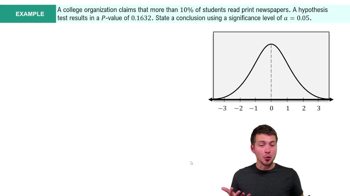
Step 1: Write Hypotheses

Significance Level (α)

The significance level, denoted as α, is the threshold for determining whether a result is statistically significant. Commonly set at 0.05, it represents the probability of rejecting the null hypothesis when it is actually true (Type I error). Changing the significance level to 0.01 makes it more stringent, requiring stronger evidence to reject the null hypothesis, which could affect the conclusion of the hypothesis test.
Recommended video:
Guided course
04:46
Step 4: State Conclusion Example 4

Proportion Comparison

Proportion comparison involves analyzing the differences between two or more proportions to determine if they are statistically significant. In this scenario, we compare the proportion of women who spent money from a single large bill versus those who spent from smaller bills. This analysis typically employs a z-test for proportions to assess whether the observed differences are likely due to chance or reflect a true effect.
Recommended video:
Guided course
10:28
Difference in Proportions: Hypothesis Tests Example 1
Related Practice
Textbook Question

In Exercises 17–24, use the indicated Data Sets from Appendix B. The complete data sets can be found at www.TriolaStats.com. Assume that the paired sample data are simple random samples and the differences have a distribution that is approximately normal.


Heights of Presidents Repeat Exercise 12 “Heights of Presidents” using all of the sample data from Data Set 22 “Presidents” in Appendix B.

123
views
Textbook Question

P-VALUE The test statistic of z = 2.14 is obtained when using the data from Exercise 1 and testing the claim that patients treated with dexamethasone and patients given a placebo have the same rate of complete resolution.


a. Find the P-value for the test.

112
views
Textbook Question

Denomination Effect A trial was conducted with 75 women in China given a 100-yuan bill, while another 75 women in China were given 100 yuan in the form of smaller bills (a 50-yuan bill plus two 20-yuan bills plus two 5-yuan bills). Among those given the single bill, 60 spent some or all of the money. Among those given the smaller bills, 68 spent some or all of the money (based on data from “The Denomination Effect,” by Raghubir and Srivastava, Journal of Consumer Research, Vol. 36). We want to use a 0.05 significance level to test the claim that when given a single large bill, a smaller proportion of women in China spend some or all of the money when compared to the proportion of women in China given the same amount in smaller bills.


a. Test the claim using a hypothesis test.

160
views
Textbook Question

Clinical Trials of OxyContin OxyContin (oxycodone) is a drug used to treat pain, but it is well known for its addictiveness and danger. In a clinical trial, among subjects treated with OxyContin, 52 developed nausea and 175 did not develop nausea. Among other subjects given placebos, 5 developed nausea and 40 did not develop nausea (based on data from Purdue Pharma L.P.). Use a 0.05 significance level to test for a difference between the rates of nausea for those treated with OxyContin and those given a placebo.


a. Use a hypothesis test.

186
views
Textbook Question

Denomination Effect A trial was conducted with 75 women in China given a 100-yuan bill, while another 75 women in China were given 100 yuan in the form of smaller bills (a 50-yuan bill plus two 20-yuan bills plus two 5-yuan bills). Among those given the single bill, 60 spent some or all of the money. Among those given the smaller bills, 68 spent some or all of the money (based on data from “The Denomination Effect,” by Raghubir and Srivastava, Journal of Consumer Research, Vol. 36). We want to use a 0.05 significance level to test the claim that when given a single large bill, a smaller proportion of women in China spend some or all of the money when compared to the proportion of women in China given the same amount in smaller bills.


b. Test the claim by constructing an appropriate confidence interval.

125
views