Ch. 9 - Inferences from Two Samples
Triola - Elementary Statistics 14th Edition
Triola14th EditionElementary StatisticsISBN: 9780137366446Not the one you use?Change textbook
Chapter 9, Problem 9.2.10b

In Exercises 5–20, assume that the two samples are independent simple random samples selected from normally distributed populations, and do not assume that the population standard deviations are equal. (Note: Answers in Appendix D include technology answers based on Formula 9-1 along with “Table” answers based on Table A-3 with df equal to the smaller of n1-1 and n2-1)


Color and Creativity Researchers from the University of British Columbia conducted trials to investigate the effects of color on creativity. Subjects with a red background were asked to think of creative uses for a brick; other subjects with a blue background were given the same task. Responses were scored by a panel of judges and results from scores of creativity are given below. Higher scores correspond to more creativity. The researchers make the claim that “blue enhances performance on a creative task.”


b. Construct the confidence interval appropriate for the hypothesis test in part (a). What is it about the confidence interval that causes us to reach the same conclusion from part (a)?


<IMAGE>

Verified step by step guidance
1
Step 1: Identify the given data for the two independent samples. For the red background group, we have n₁ = 35, x̄₁ = 3.39, and s₁ = 0.97. For the blue background group, we have n₂ = 36, x̄₂ = 3.97, and s₂ = 0.63.
Step 2: Use the formula for the confidence interval for the difference between two means when the population standard deviations are not assumed to be equal. The formula is: CI = (x̄₁ - x̄₂) ± t * √((s₁² / n₁) + (s₂² / n₂)), where t is the critical value from the t-distribution with degrees of freedom calculated using the Welch-Satterthwaite equation.
Step 3: Calculate the degrees of freedom (df) using the Welch-Satterthwaite equation: df = ((s₁² / n₁) + (s₂² / n₂))² / {[(s₁² / n₁)² / (n₁ - 1)] + [(s₂² / n₂)² / (n₂ - 1)]}. This value will determine the t critical value.
Step 4: Find the t critical value for the desired confidence level (e.g., 95%) using the degrees of freedom calculated in Step 3. Use a t-distribution table or statistical software to find this value.
Step 5: Substitute the values of x̄₁, x̄₂, s₁, s₂, n₁, n₂, and the t critical value into the confidence interval formula from Step 2. Simplify the expression to find the confidence interval. Compare the confidence interval to the null hypothesis to determine if the conclusion aligns with the hypothesis test in part (a).

Verified video answer for a similar problem:

This video solution was recommended by our tutors as helpful for the problem above.
Video duration:
5m
Was this helpful?

Key Concepts

Here are the essential concepts you must grasp in order to answer the question correctly.

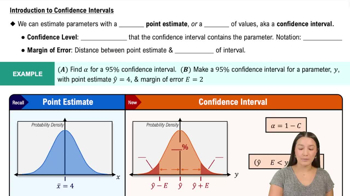
Confidence Interval

A confidence interval is a range of values, derived from sample statistics, that is likely to contain the true population parameter. It provides an estimate of uncertainty around a sample mean, allowing researchers to infer whether a hypothesis about population means is plausible. The width of the interval reflects the level of confidence and the variability in the data; a wider interval indicates more uncertainty.
Recommended video:
06:33
Introduction to Confidence Intervals

Hypothesis Testing

Hypothesis testing is a statistical method used to make decisions about population parameters based on sample data. It involves formulating a null hypothesis (typically stating no effect or difference) and an alternative hypothesis (indicating an effect or difference). Researchers use sample data to calculate a test statistic and determine whether to reject the null hypothesis, often using a significance level to guide their decision.
Recommended video:
Guided course
06:21
Step 1: Write Hypotheses

Independent Samples

Independent samples refer to two or more groups of data that are collected separately and do not influence each other. In the context of hypothesis testing, this means that the observations in one sample do not affect the observations in another. This assumption is crucial for applying certain statistical tests, such as the t-test, which compares means from different groups to determine if there is a significant difference between them.
Recommended video:
05:11
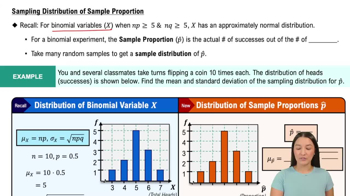
Sampling Distribution of Sample Proportion
Related Practice
Textbook Question

F Test Statistic


b. Can the F test statistic ever be a negative number?


312
views

Textbook Question

In Exercises 5–20, assume that the two samples are independent simple random samples selected from normally distributed populations, and do not assume that the population standard deviations are equal. (Note: Answers in Appendix D include technology answers based on Formula 9-1 along with “Table” answers based on Table A-3 with df equal to the smaller of n1-1 and n2-1)


Better Tips by Giving Candy An experiment was conducted to determine whether giving candy to dining parties resulted in greater tips. The mean tip percentages and standard deviations are given below along with the sample sizes (based on data from “Sweetening the Till: The Use of Candy to Increase Restaurant Tipping,” by Strohmetz et al., Journal of Applied Social Psychology, Vol. 32, No. 2).


a. Use a 0.05 significance level to test the claim that giving candy does result in greater tips.

[Image]

149
views
Textbook Question

In Exercises 5–16, use the listed paired sample data, and assume that the samples are simple random samples and that the differences have a distribution that is approximately normal.


Heights of Presidents A popular theory is that presidential candidates have an advantage if they are taller than their main opponents. Listed are heights (cm) of presidents along with the heights of their main opponents (from Data Set 22 “Presidents” in Appendix B).


a. Use the sample data with a 0.05 significance level to test the claim that for the population of heights of presidents and their main opponents, the differences have a mean greater than 0 cm.


119
views
Textbook Question

Cigarette Pack Warnings A study was conducted to find the effects of cigarette pack warnings that consisted of text or pictures. Among 1078 smokers given cigarette packs with text warnings, 366 tried to quit smoking. Among 1071 smokers given cigarette packs with warning pictures, 428 tried to quit smoking. (Results are based on data from “Effect of Pictorial Cigarette Pack Warnings on Changes in Smoking Behavior,” by Brewer et al., Journal of the American Medical Association.) Use a 0.01 significance level to test the claim that the proportion of smokers who tried to quit in the text warning group is less than the proportion in the picture warning group.


b. Test the claim by constructing an appropriate confidence interval.

71
views
Textbook Question

Hypotheses and Conclusions Refer to the hypothesis test described in Exercise 1.


b. If the P-value for the test is reported as “less than 0.001,” what should we conclude about the original claim?

182
views
Textbook Question

Are Seat Belts Effective? A simple random sample of front-seat occupants involved in car crashes is obtained. Among 2823 occupants not wearing seat belts, 31 were killed. Among 7765 occupants wearing seat belts, 16 were killed (based on data from “Who Wants Airbags?” by Meyer and Finney, Chance, Vol. 18, No. 2). We want to use a 0.05 significance level to test the claim that seat belts are effective in reducing fatalities.


b. Test the claim by constructing an appropriate confidence interval.


110
views