Ch. 9 - Inferences from Two Samples
Triola - Elementary Statistics 14th Edition
Triola14th EditionElementary StatisticsISBN: 9780137366446Not the one you use?Change textbook
Chapter 9, Problem 9.2.2a

Pulse Rates of Women and Men Using the samples of women and men included in Data Set 1 “Body Data,” we get this 95% confidence interval estimate of the difference between the population mean of pulse rates (bpm) of women and the population mean of pulse rates (bpm) of men: 1.7 bpm < u1-u2 < 7.2bpm. In this confidence interval, women correspond to population 1 and men correspond to population 2.


a. What does the confidence interval suggest about equality of the mean pulse rate of women and the mean pulse rate of men?

Verified step by step guidance
1
Identify the confidence interval provided in the problem: 1.7 bpm < μ₁ - μ₂ < 7.2 bpm, where μ₁ represents the mean pulse rate of women and μ₂ represents the mean pulse rate of men.
Interpret the confidence interval: Since the entire interval (1.7 bpm to 7.2 bpm) is positive, it suggests that the mean pulse rate of women (μ₁) is consistently higher than the mean pulse rate of men (μ₂).
Explain the implication of the interval not including 0: If the confidence interval included 0, it would suggest that there is a possibility of no difference between the two means. However, since 0 is not within the interval, we can infer that there is a statistically significant difference between the mean pulse rates of women and men.
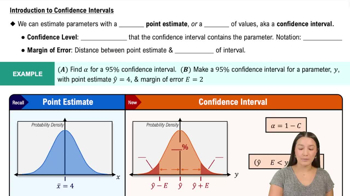
Discuss the level of confidence: The 95% confidence level means that if we were to take many random samples and compute confidence intervals for each, approximately 95% of those intervals would contain the true difference between the population means.
Conclude the interpretation: The confidence interval suggests that the mean pulse rate of women is higher than that of men, with a difference between 1.7 bpm and 7.2 bpm, based on the given data and confidence level.

Verified video answer for a similar problem:

This video solution was recommended by our tutors as helpful for the problem above.
Video duration:
2m
Was this helpful?

Key Concepts

Here are the essential concepts you must grasp in order to answer the question correctly.

Confidence Interval

A confidence interval is a range of values, derived from sample statistics, that is likely to contain the true population parameter with a specified level of confidence, typically 95%. In this case, the interval of 1.7 bpm to 7.2 bpm suggests that we can be 95% confident that the true difference in mean pulse rates between women and men lies within this range.
Recommended video:
06:33
Introduction to Confidence Intervals

Population Mean

The population mean is the average value of a characteristic (like pulse rate) across an entire population. In this context, u1 represents the mean pulse rate of women, and u2 represents the mean pulse rate of men. Understanding these means is crucial for interpreting the confidence interval and assessing whether there is a significant difference between the two groups.
Recommended video:
04:48
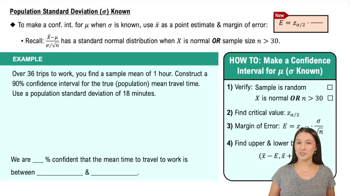
Population Standard Deviation Known

Hypothesis Testing

Hypothesis testing is a statistical method used to determine whether there is enough evidence to reject a null hypothesis, which often states that there is no effect or difference. In this scenario, the null hypothesis would suggest that the mean pulse rates of women and men are equal. The confidence interval provides insight into this hypothesis, as it does not include zero, indicating a significant difference between the two means.
Recommended video:
Guided course
06:21
Step 1: Write Hypotheses
Related Practice
Textbook Question

F Test Statistic


a. If s2,1 represents the larger of two sample variances, can the F test statistic ever be less than 1?


109
views

Textbook Question

In Exercises 5–16, use the listed paired sample data, and assume that the samples are simple random samples and that the differences have a distribution that is approximately normal.


The Freshman 15 The “Freshman 15” refers to the belief that college students gain 15 lb (or 6.8 kg) during their freshman year. Listed below are weights (kg) of randomly selected male college freshmen (from Data Set 13 “Freshman 15” in Appendix B). The weights were measured in September and later in April.


a. Use a 0.01 significance level to test the claim that for the population of freshman male college students, the weights in September are less than the weights in the following April.

151
views
Textbook Question

Variation of Hospital Times Use the sample data given in Exercise 7 “Seat Belts” and test the claim that for children hospitalized after motor vehicle crashes, the numbers of days in intensive care units for those wearing seat belts and for those not wearing seat belts have the same variation. Use a 0.05 significance level.

35
views
Textbook Question

Friday the 13th Refer to the sample data from Exercise 1.


a. Find the differences d, then find the values of d_bar and sd

156
views
Textbook Question

In Exercises 5–20, assume that the two samples are independent simple random samples selected from normally distributed populations, and do not assume that the population standard deviations are equal. (Note: Answers in Appendix D include technology answers based on Formula 9-1 along with “Table” answers based on Table A-3 with df equal to the smaller of n1-1 and n2-1)


Color and Cognition Researchers from the University of British Columbia conducted a study to investigate the effects of color on cognitive tasks. Words were displayed on a computer screen with background colors of red and blue. Results from scores on a test of word recall are given below. Higher scores correspond to greater word recall.


a. Use a 0.05 significance level to test the claim that the samples are from populations with the same mean.


" style="" width="440">

112
views
Textbook Question

Count Five Test for Comparing Variation in Two Populations Repeat Exercise 16 “Blanking Out on Tests,” but instead of using the F test, use the following procedure for the “count five” test of equal variations (which is not as complicated as it might appear).

a. For each value x in the first sample, find the absolute deviation |x-x_bar| then sort the absolute deviation values. Do the same for the second sample.

38
views