
Ch. 9 - Inferences from Two Samples
Triola - Elementary Statistics 14th Edition
Triola14th EditionElementary StatisticsISBN: 9780137366446Not the one you use?Change textbook
Chapter 9, Problem 9.R.5

Smoking Cessation Programs Among 198 smokers who underwent a “sustained care” program, 51 were no longer smoking after six months. Among 199 smokers who underwent a “standard care” program, 30 were no longer smoking after six months (based on data from “Sustained Care Intervention and Postdischarge Smoking Cessation Among Hospitalized Adults,” by Rigotti et al., Journal of the American Medical Association, Vol. 312, No. 7). We want to use a 0.01 significance level to test the claim that the rate of success for smoking cessation is greater with the sustained care program. Test the claim using a hypothesis test.

Verified step by step guidance
1
Step 1: Define the null and alternative hypotheses. The null hypothesis (H₀) states that the success rate for smoking cessation is the same for both programs: p₁ = p₂. The alternative hypothesis (H₁) states that the success rate for smoking cessation is greater for the sustained care program: p₁ > p₂.
Step 2: Identify the sample proportions and sample sizes. For the sustained care program, the sample size is n₁ = 198 and the number of successes is x₁ = 51, so the sample proportion is p̂₁ = x₁ / n₁. For the standard care program, the sample size is n₂ = 199 and the number of successes is x₂ = 30, so the sample proportion is p̂₂ = x₂ / n₂.
Step 3: Calculate the pooled proportion (p̂) using the formula: p̂ = (x₁ + x₂) / (n₁ + n₂). This pooled proportion represents the overall success rate across both groups.
Step 4: Compute the test statistic (z) using the formula: z = (p̂₁ - p̂₂) / √[p̂(1 - p̂)(1/n₁ + 1/n₂)]. This formula accounts for the difference in sample proportions and the variability of the pooled proportion.
Step 5: Compare the test statistic (z) to the critical value for a one-tailed test at the 0.01 significance level. If z exceeds the critical value, reject the null hypothesis and conclude that the sustained care program has a higher success rate. Otherwise, fail to reject the null hypothesis.

Verified video answer for a similar problem:

This video solution was recommended by our tutors as helpful for the problem above.
Video duration:
6m
Was this helpful?

Key Concepts

Here are the essential concepts you must grasp in order to answer the question correctly.

Hypothesis Testing

Hypothesis testing is a statistical method used to make decisions about a population based on sample data. It involves formulating two competing hypotheses: the null hypothesis (H0), which represents no effect or no difference, and the alternative hypothesis (H1), which indicates the presence of an effect or difference. In this case, the null hypothesis would state that the success rate of the sustained care program is equal to or less than that of the standard care program.
Recommended video:
Guided course
06:21
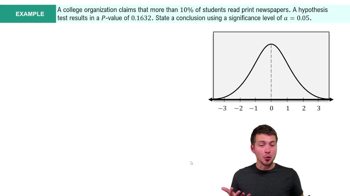
Step 1: Write Hypotheses

Significance Level

The significance level, denoted as alpha (α), is the threshold for determining whether to reject the null hypothesis. It represents the probability of making a Type I error, which occurs when the null hypothesis is incorrectly rejected. In this scenario, a significance level of 0.01 indicates that there is a 1% risk of concluding that the sustained care program is more effective when it is not.
Recommended video:
Guided course
04:46
Step 4: State Conclusion Example 4

P-Value

The p-value is a statistical measure that helps determine the strength of the evidence against the null hypothesis. It quantifies the probability of observing the sample data, or something more extreme, assuming the null hypothesis is true. If the p-value is less than the significance level (0.01 in this case), it suggests that the observed success rate difference is statistically significant, leading to the rejection of the null hypothesis in favor of the alternative.
Recommended video:
Guided course
06:50
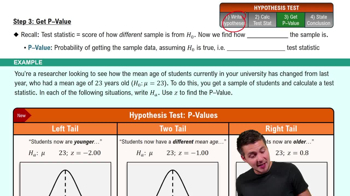
Step 3: Get P-Value
Related Practice
Textbook Question

Forecast and Actual Temperatures Listed below are actual temperatures (°F) along with the temperatures that were forecast five days earlier (data collected by the author). Use a 0.05 significance level to test the claim that differences between actual temperatures and temperatures forecast five days earlier are from a population with a mean of 0°F.

104
views
Textbook Question

Smoking Cessation Programs


a. Construct the confidence interval that could be used to test the claim in Exercise 5. What feature of the confidence interval leads to the same conclusion from Exercise 5?

133
views
Textbook Question

Test Values p_cap1, p_cap2. Find the values of and the pooled proportion p_bar obtained when testing the claim given in Exercise 1.

184
views
Textbook Question

Body Temperatures Listed below are body temperatures from six different subjects measured at two different times in a day (from Data Set 5 “Body Temperatures” in Appendix B).


b. Identify the null and alternative hypotheses for using the sample data to test the claim that the differences between 8 AM temperatures and 12 AM temperatures are from a population with a mean equal to 0°F

116
views
Textbook Question

In Exercises 5–16, use the listed paired sample data, and assume that the samples are simple random samples and that the differences have a distribution that is approximately normal.


The Freshman 15 The “Freshman 15” refers to the belief that college students gain 15 lb (or 6.8 kg) during their freshman year. Listed below are weights (kg) of randomly selected male college freshmen (from Data Set 13 “Freshman 15” in Appendix B). The weights were measured in September and later in April.


a. Use a 0.01 significance level to test the claim that for the population of freshman male college students, the weights in September are less than the weights in the following April.

151
views
Textbook Question

Variation of Hospital Times Use the sample data given in Exercise 7 “Seat Belts” and test the claim that for children hospitalized after motor vehicle crashes, the numbers of days in intensive care units for those wearing seat belts and for those not wearing seat belts have the same variation. Use a 0.05 significance level.

35
views