
Ch. 9 - Inferences from Two Samples
Triola - Elementary Statistics 14th Edition
Triola14th EditionElementary StatisticsISBN: 9780137366446Not the one you use?Change textbook
Chapter 9, Problem 9

Testing Effects of Alcohol Researchers conducted an experiment to test the effects of alcohol. Errors were recorded in a test of visual and motor skills for a treatment group of 22 people who drank ethanol and another group of 22 people given a placebo. The errors for the treatment group have a standard deviation of 2.20, and the errors for the placebo group have a standard deviation of 0.72 (based on data from “Effects of Alcohol Intoxication on Risk Taking, Strategy, and Error Rate in Visuomotor Performance,” by Streufert et al., Journal of Applied Psychology, Vol. 77, No. 4). Use a 0.05 significance level to test the claim that both groups have the same amount of variation among the errors.

Verified step by step guidance
1
Step 1: Identify the hypothesis to be tested. The null hypothesis (H₀) states that the variances of the two groups are equal (σ₁² = σ₂²), while the alternative hypothesis (H₁) states that the variances are not equal (σ₁² ≠ σ₂²). This is a two-tailed test.
Step 2: Determine the test statistic to use. Since we are comparing variances, we use the F-test for equality of variances. The test statistic is calculated as F = (s₁² / s₂²), where s₁ and s₂ are the sample standard deviations of the two groups. Assign the larger variance to the numerator to ensure F ≥ 1.
Step 3: Calculate the degrees of freedom for both groups. For the treatment group, the degrees of freedom are df₁ = n₁ - 1, where n₁ is the sample size of the treatment group. For the placebo group, the degrees of freedom are df₂ = n₂ - 1, where n₂ is the sample size of the placebo group.
Step 4: Determine the critical value for the F-distribution at a significance level of 0.05. Since this is a two-tailed test, divide the significance level by 2 for each tail (0.025 in each tail). Use an F-distribution table or statistical software to find the critical values corresponding to df₁ and df₂.
Step 5: Compare the calculated F-statistic to the critical values. If the F-statistic falls outside the range defined by the critical values, reject the null hypothesis (H₀). Otherwise, fail to reject the null hypothesis. Conclude whether there is sufficient evidence to support the claim that the variances are different.

Verified video answer for a similar problem:

This video solution was recommended by our tutors as helpful for the problem above.
Video duration:
5m
Was this helpful?

Key Concepts

Here are the essential concepts you must grasp in order to answer the question correctly.

Standard Deviation

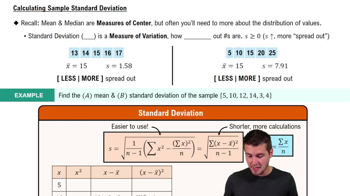
Standard deviation is a statistical measure that quantifies the amount of variation or dispersion in a set of data values. A low standard deviation indicates that the data points tend to be close to the mean, while a high standard deviation indicates that the data points are spread out over a wider range of values. In this context, it helps to understand the variability in errors between the treatment and placebo groups.
Recommended video:
Guided course
08:45
Calculating Standard Deviation

Hypothesis Testing

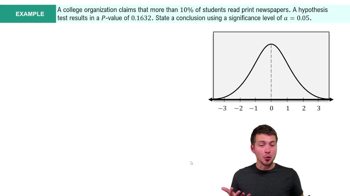
Hypothesis testing is a statistical method used to make decisions about a population based on sample data. It involves formulating a null hypothesis (which states there is no effect or difference) and an alternative hypothesis (which states there is an effect or difference). In this case, the null hypothesis would assert that both groups have the same variation in errors, while the alternative would suggest a difference.
Recommended video:
Guided course
06:21
Step 1: Write Hypotheses

Significance Level

The significance level, often denoted as alpha (α), is the threshold used to determine whether to reject the null hypothesis in hypothesis testing. A common significance level is 0.05, which indicates a 5% risk of concluding that a difference exists when there is none. In this experiment, using a 0.05 significance level means that if the p-value is less than 0.05, the researchers would reject the null hypothesis and conclude that there is a significant difference in variation between the two groups.
Recommended video:
Guided course
04:46
Step 4: State Conclusion Example 4
Related Practice
Textbook Question

Finding Critical Values

In Exercises 17–20, refer to the information in the given exercise and use a 0.05 significance level for the following.


a. Find the critical value(s).

b. Should we reject H0 or should we fail to reject H0?


Exercise 14

104
views
Textbook Question

In Exercises 5–8, use (a) randomization and (b) bootstrapping for the indicated exercise from Section 9-1. Compare the results to those obtained in the original exercise.


Exercise 8 in Section 9-1 “Tennis Challenges”


89
views
Textbook Question

Color and Recall Researchers from the University of British Columbia conducted trials to investigate the effects of color on the accuracy of recall. Subjects were given tasks consisting of words displayed on a computer screen with background colors of red and blue. The subjects studied 36 words for 2 minutes, and then they were asked to recall as many of the words as they could after waiting 20 minutes. Results from scores on the word recall test are given below. Use a 0.05 significance level to test the claim that variation of scores is the same with the red background and blue background.


[Image]

125
views
Textbook Question

In Exercises 5–8, use (a) randomization and (b) bootstrapping for the indicated exercise from Section 9-1. Compare the results to those obtained in the original exercise.


Exercise 9 in Section 9-1 “Cell Phones and Handedness”


81
views
Textbook Question

Degrees of Freedom For Example 1, we used df=smaller of n1-1 and n2-1 we got df=11 and the corresponding critical value is t=-1.796 (found from Table A-4). If we calculate df using Formula 9-1, we get df=19.370 and the corresponding critical value is t=-1.727 How is using the critical value of t=-1.796 “more conservative” than using the critical value of t=-1.727

241
views
Textbook Question

In Exercises 17–24, use the indicated Data Sets from Appendix B. The complete data sets can be found at www.TriolaStats.com. Assume that the paired sample data are simple random samples and the differences have a distribution that is approximately normal.

Measured and Reported Weights Repeat Example 1 using all of the 2784 measured and reported weights of males listed in Data Set 4 “Measured and Reported” in Appendix B. Did the larger data set have much of an effect on the results?

106
views