In Exercises 23–32, use the dot product to determine whether v and w are orthogonal. v = 3i, w = -4i
Verified step by step guidance
1
Recall that two vectors \( \mathbf{v} \) and \( \mathbf{w} \) are orthogonal if their dot product is zero, i.e., \( \mathbf{v} \cdot \mathbf{w} = 0 \).
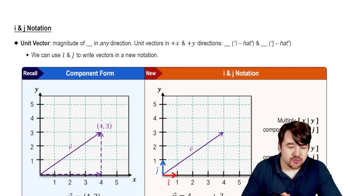
Write the given vectors in component form: \( \mathbf{v} = 3\mathbf{i} = (3, 0) \) and \( \mathbf{w} = -4\mathbf{i} = (-4, 0) \).
Calculate the dot product using the formula \( \mathbf{v} \cdot \mathbf{w} = v_x w_x + v_y w_y \).
Substitute the components into the dot product formula: \( 3 \times (-4) + 0 \times 0 \).
Evaluate the expression to check if the dot product equals zero; if it does, the vectors are orthogonal, otherwise they are not.
Verified video answer for a similar problem:
This video solution was recommended by our tutors as helpful for the problem above
Video duration:
2m
Play a video:
0 Comments
Key Concepts
Here are the essential concepts you must grasp in order to answer the question correctly.
Dot Product
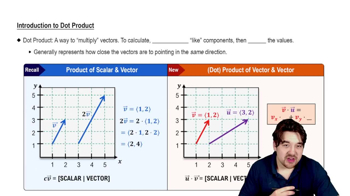
The dot product of two vectors is a scalar calculated by multiplying corresponding components and summing the results. For vectors v and w, it is v · w = v₁w₁ + v₂w₂ + ... . It measures how much one vector extends in the direction of another.
Two vectors are orthogonal if their dot product equals zero. This means they are perpendicular to each other in the vector space, indicating no directional overlap.
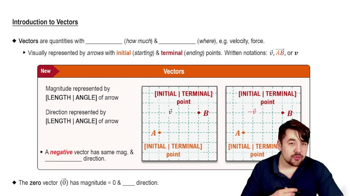
Vectors are expressed in terms of unit vectors i, j, k representing the x, y, and z axes. Understanding how to interpret and manipulate these components is essential for calculating the dot product and analyzing vector relationships.

 2:04 minutes
 Verified step by step guidance
 05:40
05:40