In Exercises 33–40, polar coordinates of a point are given. Find the rectangular coordinates of each point. (7.4, 2.5)
Verified step by step guidance
1
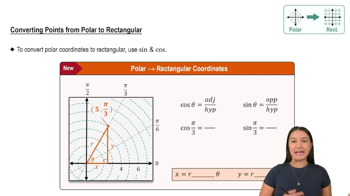
Recall the relationship between polar coordinates \((r, \theta)\) and rectangular coordinates \((x, y)\), where \(x = r \cos(\theta)\) and \(y = r \sin(\theta)\).
Identify the given polar coordinates: \(r = 7.4\) and \(\theta = 2.5\) radians.
Calculate the \(x\)-coordinate using the formula \(x = 7.4 \times \cos(2.5)\).
Calculate the \(y\)-coordinate using the formula \(y = 7.4 \times \sin(2.5)\).
Express the rectangular coordinates as the ordered pair \((x, y)\) using the values found in the previous steps.
Verified video answer for a similar problem:
This video solution was recommended by our tutors as helpful for the problem above
Video duration:
3m
Play a video:
0 Comments
Key Concepts
Here are the essential concepts you must grasp in order to answer the question correctly.
Polar Coordinates
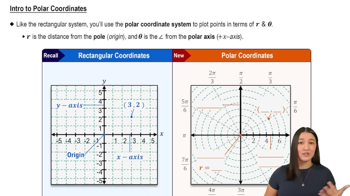
Polar coordinates represent a point in the plane using a distance from the origin (radius r) and an angle (θ) measured from the positive x-axis. The given point (7.4, 2.5) means r = 7.4 and θ = 2.5 radians.
To convert polar coordinates (r, θ) to rectangular coordinates (x, y), use the formulas x = r cos(θ) and y = r sin(θ). This translates the point from a radius-angle format to Cartesian coordinates on the xy-plane.
Sine and cosine functions relate an angle in a right triangle to the ratios of its sides. Cosine gives the ratio of the adjacent side to the hypotenuse, and sine gives the ratio of the opposite side to the hypotenuse, essential for coordinate conversion.