Identify the given information for the sector: the radius \(r\) of the circle and the central angle \(\theta\) of the sector. The angle should be in degrees or radians.
Recall the formula for the area of a sector: \(\text{Area} = \frac{\theta}{360} \times \pi r^{2}\) if \(\theta\) is in degrees, or \(\text{Area} = \frac{1}{2} r^{2} \theta\) if \(\theta\) is in radians.
If the angle \(\theta\) is given in degrees, use the first formula. If it is in radians, use the second formula. Convert the angle to the appropriate unit if necessary.
Substitute the values of \(r\) and \(\theta\) into the chosen formula to set up the expression for the area of the sector.
Simplify the expression to find the area of the sector (do not calculate the final numeric value unless asked).
Verified video answer for a similar problem:
This video solution was recommended by our tutors as helpful for the problem above
Play a video:
0 Comments
Key Concepts
Here are the essential concepts you must grasp in order to answer the question correctly.
Definition of a Sector
A sector is a portion of a circle enclosed by two radii and the arc between them. Understanding what constitutes a sector helps in visualizing the problem and identifying the relevant parts of the circle needed to calculate the area.
The area of a sector is given by (θ/360) × πr², where θ is the central angle in degrees and r is the radius of the circle. This formula relates the fraction of the circle represented by the sector to the total area of the circle.
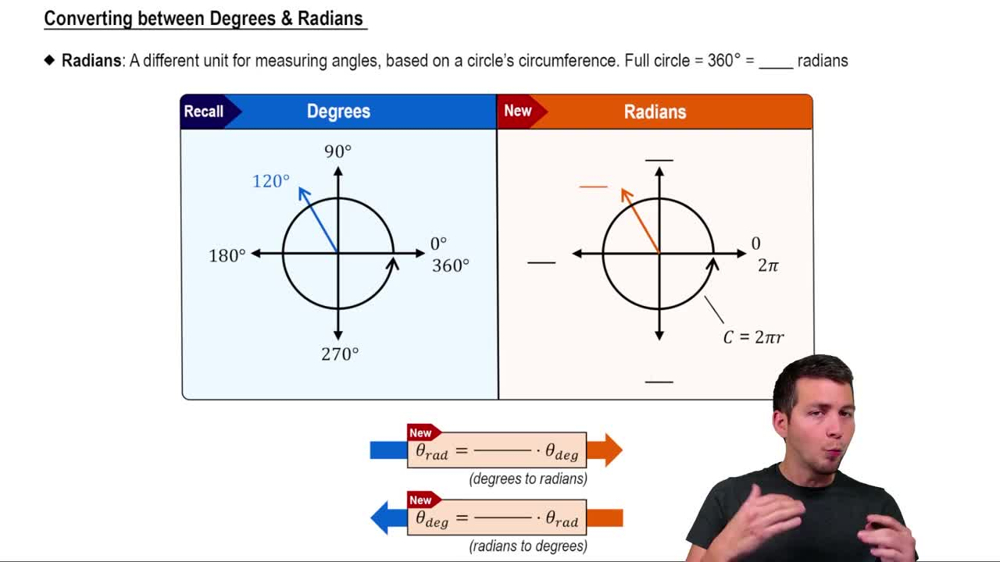
Since angles can be given in radians or degrees, knowing how to convert between these units (1 radian = 180/π degrees) is essential. This ensures the correct application of the area formula depending on the angle's unit.

 Verified step by step guidance
 04:26
04:26