Convert each angle measure to decimal degrees. If applicable, round to the nearest thousandth of a degree. - 70° 48'
Table of contents
- 0. Review of College Algebra4h 45m
- 1. Measuring Angles40m
- 2. Trigonometric Functions on Right Triangles2h 5m
- 3. Unit Circle1h 19m
- 4. Graphing Trigonometric Functions1h 19m
- 5. Inverse Trigonometric Functions and Basic Trigonometric Equations1h 41m
- 6. Trigonometric Identities and More Equations2h 34m
- 7. Non-Right Triangles1h 38m
- 8. Vectors2h 25m
- 9. Polar Equations2h 5m
- 10. Parametric Equations1h 6m
- 11. Graphing Complex Numbers1h 7m
1. Measuring Angles
Angles in Standard Position
Problem 70
Textbook Question
Convert each angle measure to degrees, minutes, and seconds. If applicable, round to the nearest second. -25.485°
Verified step by step guidance1
Identify the given angle in decimal degrees: \(-25.485^\circ\).
Separate the angle into its degrees part and the decimal part. The degrees part is the integer portion, which is \(-25^\circ\).
Take the absolute value of the decimal part (ignore the negative sign for now) to convert it into minutes: multiply \$0.485\( by \)60$ to get the minutes.
Separate the minutes into its integer part and decimal part. The integer part is the minutes, and the decimal part will be converted into seconds by multiplying by \$60$.
Combine the degrees, minutes, and seconds, and then reapply the negative sign to the degrees to reflect the original angle's direction.
Verified video answer for a similar problem:This video solution was recommended by our tutors as helpful for the problem above
Video duration:
3mPlay a video:
0 Comments
Key Concepts
Here are the essential concepts you must grasp in order to answer the question correctly.
Decimal Degrees to Degrees, Minutes, and Seconds Conversion
This concept involves converting an angle expressed in decimal degrees into degrees, minutes, and seconds (D° M' S"). One degree equals 60 minutes, and one minute equals 60 seconds. The integer part of the decimal degree is the degrees, the decimal remainder multiplied by 60 gives minutes, and the remaining decimal part of minutes multiplied by 60 gives seconds.
Recommended video:
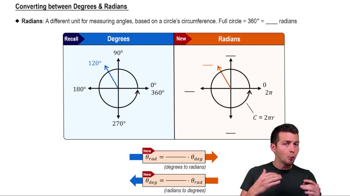
Converting between Degrees & Radians
Handling Negative Angles in Angle Conversion
When converting negative angles, the sign applies to the degrees, while minutes and seconds remain positive values. This means the angle is measured in the opposite direction, but minutes and seconds are always expressed as positive quantities to maintain clarity in the angle's components.
Recommended video:
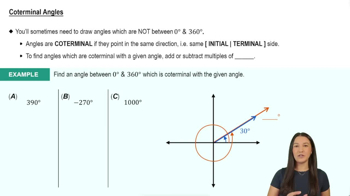
Coterminal Angles
Rounding to the Nearest Second
After calculating seconds from the decimal part of minutes, rounding to the nearest whole number is necessary for precision. This ensures the angle is expressed in a standard format, making it easier to interpret and use in further calculations or applications.
Recommended video:
How to Use a Calculator for Trig Functions
Related Videos
Related Practice
Textbook Question
557
views