Use a calculator to evaluate each expression. cos 75°29' cos 14°31' - sin 75°29' sin 14°31'
Table of contents
- 0. Review of College Algebra4h 45m
- 1. Measuring Angles40m
- 2. Trigonometric Functions on Right Triangles2h 5m
- 3. Unit Circle1h 19m
- 4. Graphing Trigonometric Functions1h 19m
- 5. Inverse Trigonometric Functions and Basic Trigonometric Equations1h 41m
- 6. Trigonometric Identities and More Equations2h 34m
- 7. Non-Right Triangles1h 38m
- 8. Vectors2h 25m
- 9. Polar Equations2h 5m
- 10. Parametric Equations1h 6m
- 11. Graphing Complex Numbers1h 7m
3. Unit Circle
Trigonometric Functions on the Unit Circle
Problem 2.3.83
Textbook Question
(Modeling) Fish's View of the World The figure shows a fish's view of the world above the surface of the water. (Data from Walker, J., 'The Amateur Scientist,' Scientific American.) Suppose that a light ray comes from the horizon, enters the water, and strikes the fish's eye. Assume that this ray gives a value of 90° for angle θ₁ in the formula for Snell's law. (In a practical situation, this angle would probably be a little less than 90°.) The speed of light in water is about 2.254 x 10⁸ m per sec. Find angle θ₂ to the nearest tenth.
Verified step by step guidance1
Identify the given information: the angle of incidence \( \theta_1 = 90^\circ \) (the angle the light ray makes with the normal as it enters the water), and the speed of light in water \( v_2 = 2.254 \times 10^8 \) m/s. The speed of light in air \( v_1 \) is approximately \( 3.00 \times 10^8 \) m/s.
Recall Snell's Law, which relates the angles and speeds of light in two media:
\[ \\sin(\theta_1) \\times v_1 = \\sin(\theta_2) \\times v_2 \]
Since \( \theta_1 = 90^\circ \), \( \\sin(90^\circ) = 1 \), so the equation simplifies to:
\[ v_1 = \\sin(\theta_2) \\times v_2 \]
Solve for \( \\sin(\theta_2) \):
\[ \\sin(\theta_2) = \\frac{v_1}{v_2} \]
Calculate \( \theta_2 \) by taking the inverse sine (arcsin) of the ratio:
\[ \theta_2 = \\arcsin \\left( \\frac{v_1}{v_2} \\right) \]
Round the result to the nearest tenth of a degree.
Verified video answer for a similar problem:This video solution was recommended by our tutors as helpful for the problem above
Video duration:
2mPlay a video:
0 Comments
Key Concepts
Here are the essential concepts you must grasp in order to answer the question correctly.
Snell's Law
Snell's Law describes how light bends when it passes between two media with different refractive indices. It states that n₁ sin(θ₁) = n₂ sin(θ₂), where n₁ and n₂ are the refractive indices and θ₁ and θ₂ are the angles of incidence and refraction. This law is essential for calculating the angle of refraction when light enters water from air.
Recommended video:
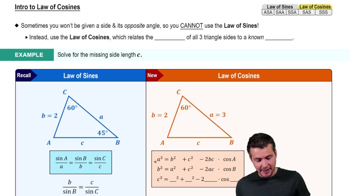
Intro to Law of Cosines
Refractive Index and Speed of Light in Media
The refractive index (n) of a medium is the ratio of the speed of light in a vacuum to its speed in that medium. Since light travels slower in water than in air, water has a higher refractive index. Knowing the speed of light in water allows calculation of its refractive index, which is crucial for applying Snell's Law.
Critical Angle and Total Internal Reflection
The critical angle is the angle of incidence above which light cannot pass through the boundary and is instead totally internally reflected. When θ₁ approaches 90°, it relates to the critical angle scenario, affecting how light rays from the horizon enter the water. Understanding this helps interpret the physical meaning of the given angle in the problem.
Recommended video:
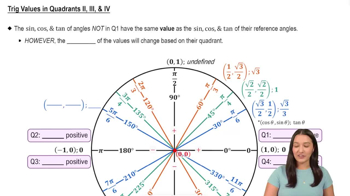
Trig Values in Quadrants II, III, & IV
Related Videos
Related Practice
Textbook Question
557
views