Find a value of θ in the interval [0°, 90°) that satisfies each statement. Give answers in decimal degrees to six decimal places. See Example 2. cot θ = 0.21563481
Verified step by step guidance
1
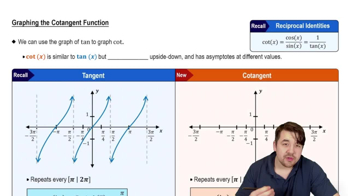
Recall the definition of cotangent in terms of tangent: \(\cot \theta = \frac{1}{\tan \theta}\). This means \(\tan \theta = \frac{1}{\cot \theta}\).
Calculate \(\tan \theta\) by taking the reciprocal of the given cotangent value: \(\tan \theta = \frac{1}{0.21563481}\).
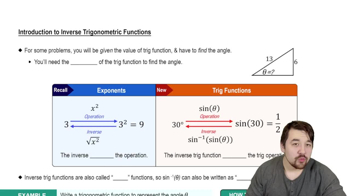
Use the inverse tangent function to find \(\theta\): \(\theta = \tan^{-1} \left( \frac{1}{0.21563481} \right)\).
Make sure your calculator is set to degree mode since the problem asks for the answer in degrees.
Evaluate the inverse tangent expression to find \(\theta\) in degrees, then round your answer to six decimal places as requested.
Verified video answer for a similar problem:
This video solution was recommended by our tutors as helpful for the problem above
Video duration:
1m
Play a video:
0 Comments
Key Concepts
Here are the essential concepts you must grasp in order to answer the question correctly.
Cotangent Function
The cotangent of an angle θ in a right triangle is the ratio of the adjacent side to the opposite side, or equivalently, cot θ = 1 / tan θ. It is the reciprocal of the tangent function and is defined for all angles where tan θ is not zero.
To find an angle given a trigonometric ratio, we use inverse functions. For cotangent, θ = arccot(value), which can be computed as θ = arctan(1 / value). This allows us to determine the angle corresponding to a specific cotangent value.
The problem restricts θ to the interval [0°, 90°), meaning the angle must be in the first quadrant where all trigonometric ratios are positive. This constraint ensures a unique solution and affects how inverse functions are interpreted.