Find the exact value of each real number y if it exists. Do not use a calculator. y = sec⁻¹ 1
Verified step by step guidance
1
Recall the definition of the inverse secant function: \(y = \sec^{-1}(x)\) means \(\sec(y) = x\) and \(y\) lies in the principal range of \(\sec^{-1}\), which is \([0, \pi]\) excluding \(\frac{\pi}{2}\).
Set up the equation from the problem: \(\sec(y) = 1\).
Recall that \(\sec(y) = \frac{1}{\cos(y)}\), so the equation becomes \(\frac{1}{\cos(y)} = 1\).
Solve for \(\cos(y)\): multiply both sides by \(\cos(y)\) and divide both sides by 1 (which does not change the equation), giving \(\cos(y) = 1\).
Find all \(y\) in the principal range \([0, \pi]\) (excluding \(\frac{\pi}{2}\)) such that \(\cos(y) = 1\). Identify these values as the solutions for \(y\).
Verified video answer for a similar problem:
This video solution was recommended by our tutors as helpful for the problem above
Play a video:
0 Comments
Key Concepts
Here are the essential concepts you must grasp in order to answer the question correctly.
Inverse Secant Function (sec⁻¹ x)
The inverse secant function, sec⁻¹ x, returns the angle whose secant is x. It is defined for |x| ≥ 1, and its range is typically [0, π] excluding π/2. Understanding this function helps find the angle y such that sec y = x.
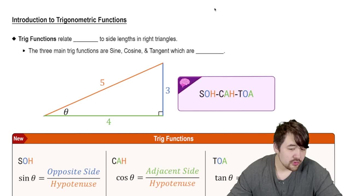
The secant function, sec θ, is the reciprocal of the cosine function: sec θ = 1/cos θ. Knowing this relationship allows you to rewrite sec⁻¹ 1 as finding an angle where cos θ = 1, simplifying the problem.
Certain angles have well-known exact trigonometric values, such as cos 0 = 1. Recognizing these standard values enables solving inverse trig problems without a calculator by matching the given value to a known angle.

 Verified step by step guidance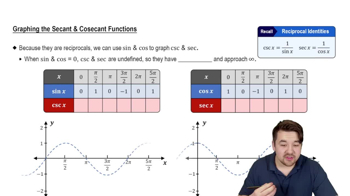
 6:22
6:22