Find the exact value of each expression. (Do not use a calculator.) cos π/12
Verified step by step guidance
1
Recognize that \( \frac{\pi}{12} \) radians is equivalent to 15 degrees, which is not a standard angle on the unit circle, so we use angle sum or difference identities to find \( \cos \frac{\pi}{12} \).
Express \( \frac{\pi}{12} \) as a difference of two common angles: \( \frac{\pi}{3} - \frac{\pi}{4} \) (which correspond to 60° and 45° respectively).
Use the cosine difference identity: \[ \cos(a - b) = \cos a \cos b + \sin a \sin b \], where \( a = \frac{\pi}{3} \) and \( b = \frac{\pi}{4} \).
Substitute the known exact values: \( \cos \frac{\pi}{3} = \frac{1}{2} \), \( \cos \frac{\pi}{4} = \frac{\sqrt{2}}{2} \), \( \sin \frac{\pi}{3} = \frac{\sqrt{3}}{2} \), and \( \sin \frac{\pi}{4} = \frac{\sqrt{2}}{2} \).
Write the expression for \( \cos \frac{\pi}{12} \) as \[ \cos \frac{\pi}{12} = \left( \frac{1}{2} \right) \left( \frac{\sqrt{2}}{2} \right) + \left( \frac{\sqrt{3}}{2} \right) \left( \frac{\sqrt{2}}{2} \right) \] and simplify the terms to get the exact value.
Verified video answer for a similar problem:
This video solution was recommended by our tutors as helpful for the problem above
Play a video:
0 Comments
Key Concepts
Here are the essential concepts you must grasp in order to answer the question correctly.
Angle Sum and Difference Identities
These identities allow the calculation of trigonometric functions for angles expressed as sums or differences of known angles. For cosine, the formula is cos(a ± b) = cos a cos b ∓ sin a sin b. This is essential for finding exact values of angles like π/12 by expressing them as π/3 - π/4.
Verifying Identities with Sum and Difference Formulas
Exact Values of Special Angles
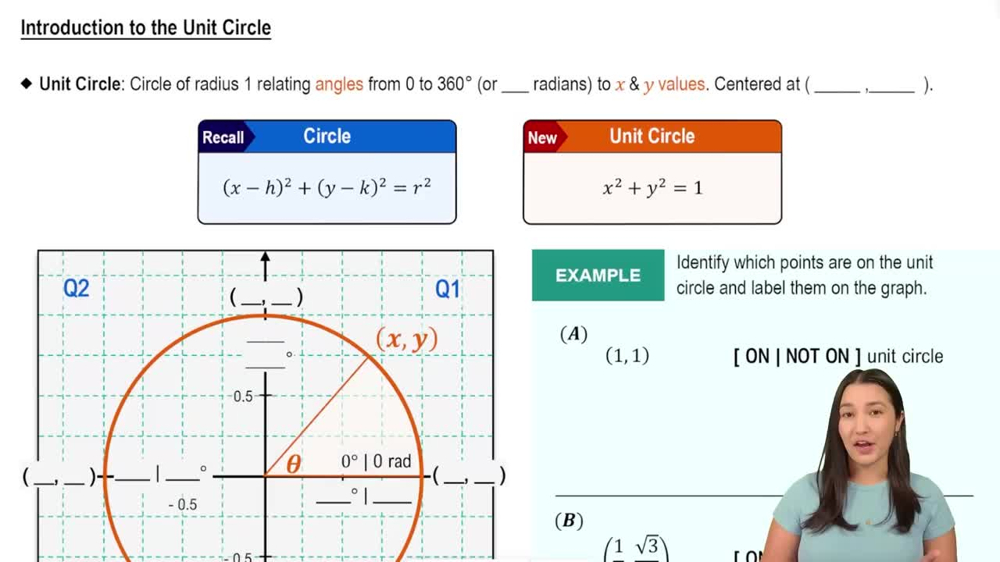
Certain angles such as π/6, π/4, and π/3 have well-known exact sine and cosine values derived from the unit circle. Knowing these values (e.g., cos π/3 = 1/2, sin π/4 = √2/2) is crucial for applying sum or difference identities without a calculator.
The unit circle represents angles in radians and their corresponding sine and cosine values. Understanding radian measure and how angles correspond to points on the unit circle helps in visualizing and computing trigonometric values exactly.

 Verified step by step guidance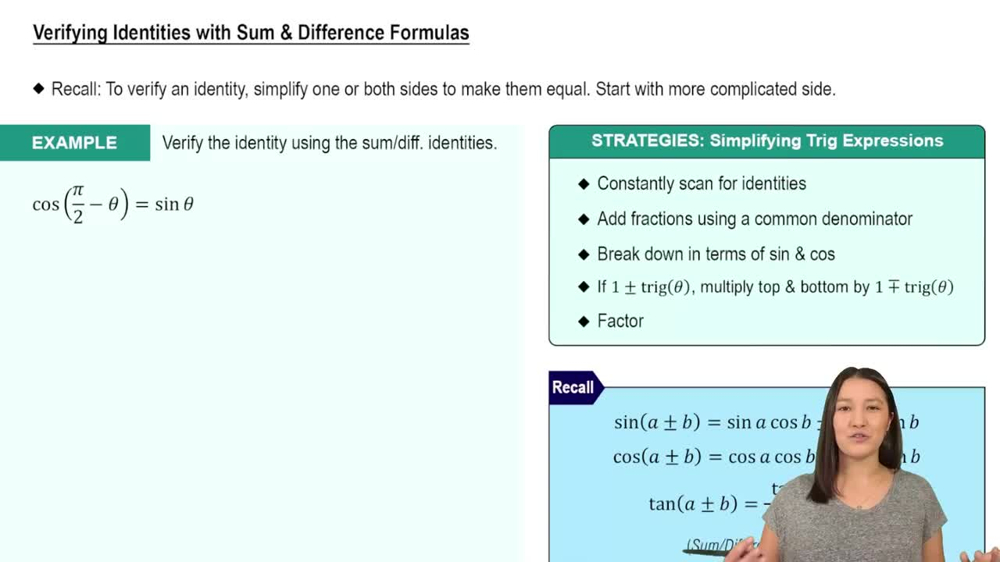
 2:25
2:25