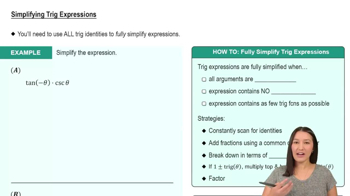
Write each expression in terms of sine and cosine, and then simplify the expression so that no quotients appear and all functions are of θ only. See Example 3. (sin θ - cos θ) (csc θ + sec θ)
Verified step by step guidance
1
Start by rewriting the given expression \((\sin \theta - \cos \theta)(\csc \theta + \sec \theta)\) in terms of sine and cosine. Recall that \(\csc \theta = \frac{1}{\sin \theta}\) and \(\sec \theta = \frac{1}{\cos \theta}\), so substitute these into the expression.
The expression becomes \((\sin \theta - \cos \theta) \left( \frac{1}{\sin \theta} + \frac{1}{\cos \theta} \right)\). Next, combine the terms inside the parentheses over a common denominator \(\sin \theta \cos \theta\).
Rewrite the sum inside the parentheses as \(\frac{\cos \theta}{\sin \theta \cos \theta} + \frac{\sin \theta}{\sin \theta \cos \theta} = \frac{\cos \theta + \sin \theta}{\sin \theta \cos \theta}\). Now the expression is \((\sin \theta - \cos \theta) \cdot \frac{\cos \theta + \sin \theta}{\sin \theta \cos \theta}\).
Multiply the numerators: \((\sin \theta - \cos \theta)(\cos \theta + \sin \theta)\). Recognize this as a product of two binomials and expand it using the distributive property (FOIL method).
After expanding, simplify the numerator by combining like terms. Then, write the entire expression as a single fraction with denominator \(\sin \theta \cos \theta\). Finally, look for any trigonometric identities or algebraic simplifications to eliminate quotients and express the result purely in terms of \(\sin \theta\) and \(\cos \theta\) without fractions.
Verified video answer for a similar problem:
This video solution was recommended by our tutors as helpful for the problem above
Play a video:
0 Comments
Key Concepts
Here are the essential concepts you must grasp in order to answer the question correctly.
Trigonometric Functions and Their Reciprocal Identities
Understanding the basic trigonometric functions sine and cosine is essential, along with their reciprocal functions cosecant (csc) and secant (sec). Csc θ is defined as 1/sin θ, and sec θ as 1/cos θ. Converting all functions to sine and cosine simplifies manipulation and helps eliminate quotients.
Algebraic Manipulation of Trigonometric Expressions
Simplifying trigonometric expressions often requires expanding products, combining like terms, and factoring. After rewriting reciprocal functions, multiplying out the terms and simplifying helps remove fractions and express the result purely in sine and cosine.
Avoiding Quotients in Trigonometric Simplification
The goal is to rewrite expressions without quotients, meaning no fractions involving sine or cosine in denominators. This involves multiplying through by common denominators or using identities to rewrite terms, ensuring the final expression contains only sine and cosine functions without division.

 Verified step by step guidance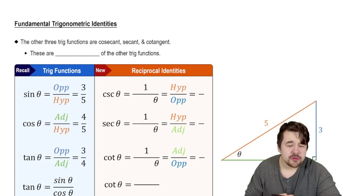
 5:32
5:32