Use a calculator to approximate each real number value. (Be sure the calculator is in radian mode.) y = sec⁻¹ (―1.2871684)
Verified step by step guidance
1
Recognize that the problem asks for the inverse secant (arcsec) of a given value, specifically \(y = \sec^{-1}(-1.2871684)\), and that the calculator must be in radian mode for the correct angle measurement.
Recall the definition of the inverse secant function: \(y = \sec^{-1}(x)\) means \(\sec(y) = x\), where \(y\) is the angle whose secant is \(x\).
Since \(\sec(y) = \frac{1}{\cos(y)}\), rewrite the equation as \(\frac{1}{\cos(y)} = -1.2871684\), which implies \(\cos(y) = \frac{1}{-1.2871684}\).
Calculate \(\cos(y)\) by taking the reciprocal of \(-1.2871684\) (without finalizing the numeric value here), then use the inverse cosine function to find \(y = \cos^{-1}\left(\frac{1}{-1.2871684}\right)\).
Use the calculator in radian mode to evaluate \(\cos^{-1}\left(\frac{1}{-1.2871684}\right)\), and interpret the result as the value of \(y = \sec^{-1}(-1.2871684)\), considering the principal value range of the inverse secant function.
Verified video answer for a similar problem:
This video solution was recommended by our tutors as helpful for the problem above
Play a video:
0 Comments
Key Concepts
Here are the essential concepts you must grasp in order to answer the question correctly.
Inverse Secant Function (sec⁻¹ or arcsec)
The inverse secant function returns the angle whose secant is a given number. Since secant is the reciprocal of cosine, sec⁻¹(x) finds an angle θ such that sec(θ) = x, with θ typically in the range [0, π] excluding π/2. Understanding its domain and range is essential for correctly interpreting the output.
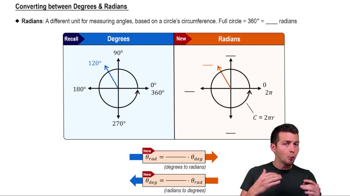
Trigonometric calculations depend on the angle unit setting of the calculator. Radian mode measures angles in radians, the standard unit in higher mathematics, where 2π radians equal 360 degrees. Ensuring the calculator is in radian mode is crucial for accurate results when working with inverse trig functions.
The secant function is defined for all real numbers except between -1 and 1, so its inverse sec⁻¹ is only defined for |x| ≥ 1. The output angle lies within [0, π] excluding π/2, which affects how the calculator interprets the input value. Recognizing these restrictions helps avoid errors and understand the solution's validity.

 Verified step by step guidance
 6:22
6:22