The Period for the function is . Determine the correct value of b.
Table of contents
- 0. Review of College Algebra4h 45m
- 1. Measuring Angles40m
- 2. Trigonometric Functions on Right Triangles2h 5m
- 3. Unit Circle1h 19m
- 4. Graphing Trigonometric Functions1h 19m
- 5. Inverse Trigonometric Functions and Basic Trigonometric Equations1h 41m
- 6. Trigonometric Identities and More Equations2h 34m
- 7. Non-Right Triangles1h 38m
- 8. Vectors2h 25m
- 9. Polar Equations2h 5m
- 10. Parametric Equations1h 6m
- 11. Graphing Complex Numbers1h 7m
4. Graphing Trigonometric Functions
Graphs of the Sine and Cosine Functions
Problem 1
Textbook Question
Fill in the blank(s) to correctly complete each sentence.
The graph of y = sin (x + π/4) is obtained by shifting the graph of y = sin x ______ unit(s) to the ________ (right/left).
Verified step by step guidance1
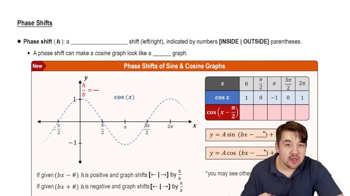
Recall that the function y = sin(x + c) represents a horizontal shift of the basic sine function y = sin x, where c is a constant.
If the function is y = sin(x + \(\frac{\pi}{4}\)), the graph is shifted horizontally by \(\frac{\pi}{4}\) units.
Since the argument inside the sine function is (x + \(\frac{\pi}{4}\)), this corresponds to a shift to the left by \(\frac{\pi}{4}\) units (because adding inside the function shifts the graph left).
Therefore, the graph of y = sin(x + \(\frac{\pi}{4}\)) is obtained by shifting the graph of y = sin x \(\frac{\pi}{4}\) unit(s) to the left.
This is a standard property of function transformations: y = sin(x + c) shifts the graph left by c units, and y = sin(x - c) shifts it right by c units.
Verified video answer for a similar problem:This video solution was recommended by our tutors as helpful for the problem above
Play a video:
0 Comments
Key Concepts
Here are the essential concepts you must grasp in order to answer the question correctly.
Phase Shift in Trigonometric Functions
Phase shift refers to the horizontal translation of a trigonometric graph caused by adding or subtracting a constant inside the function's argument. For y = sin(x + π/4), the graph shifts horizontally by π/4 units. The sign inside the function determines the direction of the shift.
Recommended video:
Phase Shifts
Graph of the Sine Function
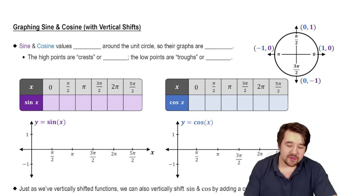
The sine function y = sin x is periodic with period 2π and oscillates between -1 and 1. Understanding its basic shape and key points helps in visualizing transformations like shifts, stretches, and reflections applied to the graph.
Recommended video:
Graph of Sine and Cosine Function
Effect of Adding a Positive Constant Inside the Function Argument
Adding a positive constant inside the argument of sine, as in sin(x + c), shifts the graph to the left by c units. This is because the input values that produce the same output occur earlier on the x-axis, effectively moving the graph leftward.
Recommended video:
Example 3
Related Videos
Related Practice
Multiple Choice
646
views
8
rank