Use the appropriate reciprocal identity to find each function value. Rationalize denominators when applicable. See Example 1. csc θ , given that sin θ = ―3/7
Table of contents
- 0. Review of College Algebra4h 45m
- 1. Measuring Angles40m
- 2. Trigonometric Functions on Right Triangles2h 5m
- 3. Unit Circle1h 19m
- 4. Graphing Trigonometric Functions1h 19m
- 5. Inverse Trigonometric Functions and Basic Trigonometric Equations1h 41m
- 6. Trigonometric Identities and More Equations2h 34m
- 7. Non-Right Triangles1h 38m
- 8. Vectors2h 25m
- 9. Polar Equations2h 5m
- 10. Parametric Equations1h 6m
- 11. Graphing Complex Numbers1h 7m
2. Trigonometric Functions on Right Triangles
Trigonometric Functions on Right Triangles
Problem 2.5.20
Textbook Question
Solve each problem. See Examples 1 and 2. Distance Traveled by a Ship A ship travels 55 km on a bearing of 27° and then travels on a bearing of 117° for 140 km. Find the distance from the starting point to the ending point.
Verified step by step guidance1
Draw a diagram representing the ship's path: start at point O, travel 55 km on a bearing of 27°, then from that point travel 140 km on a bearing of 117° to point P. This will help visualize the problem and identify the triangle formed by the starting point, the first stop, and the final position.
Convert the bearings into angles relative to a common reference, such as the horizontal axis (east direction). The first leg is at 27° from north, so measure accordingly. The second leg is at 117°, so find the angle between the two legs by calculating the difference between their bearings.
Use the Law of Cosines to find the distance from the starting point to the ending point. Label the sides of the triangle: let side a be the distance traveled on the first leg (55 km), side b be the distance on the second leg (140 km), and side c be the unknown distance from start to end. The included angle between sides a and b is the difference between the two bearings.
Write the Law of Cosines formula: \(c^2 = a^2 + b^2 - 2ab \cos(\theta)\), where \(\theta\) is the angle between the two legs. Substitute the known values for a, b, and \(\theta\) into the formula.
Solve for \(c\) by taking the square root of both sides: \(c = \sqrt{a^2 + b^2 - 2ab \cos(\theta)}\). This will give the distance from the starting point to the ending point.
Verified video answer for a similar problem:This video solution was recommended by our tutors as helpful for the problem above
Video duration:
3mPlay a video:
0 Comments
Key Concepts
Here are the essential concepts you must grasp in order to answer the question correctly.
Bearing and Direction in Navigation
Bearing is a way to describe direction using angles measured clockwise from the north. Understanding bearings like 27° and 117° helps to determine the ship's path relative to the starting point, which is essential for plotting the course on a coordinate plane.
Recommended video:
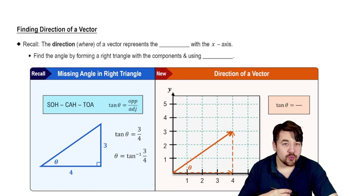
Finding Direction of a Vector
Vector Addition and Resultant Displacement
The ship's journey can be represented as two vectors based on distance and bearing. Adding these vectors involves breaking them into components and then combining them to find the resultant vector, which represents the direct distance from start to end.
Recommended video:
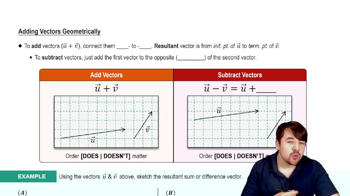
Adding Vectors Geometrically
Law of Cosines
When two sides and the included angle of a triangle are known, the Law of Cosines calculates the third side. This is useful here to find the straight-line distance between the starting and ending points after determining the angle between the two legs of the ship's path.
Recommended video:
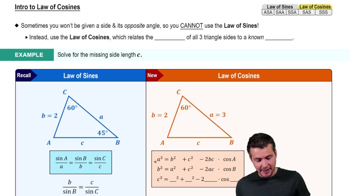
Intro to Law of Cosines
Related Videos
Related Practice
Textbook Question
892
views