In Exercises 21–40, eliminate the parameter t. Then use the rectangular equation to sketch the plane curve represented by the given parametric equations. Use arrows to show the orientation of the curve corresponding to increasing values of t. (If an interval for t is not specified, assume that −∞ < t < ∞. x = t, y = 2t
Table of contents
- 0. Review of College Algebra4h 45m
- 1. Measuring Angles40m
- 2. Trigonometric Functions on Right Triangles2h 5m
- 3. Unit Circle1h 19m
- 4. Graphing Trigonometric Functions1h 19m
- 5. Inverse Trigonometric Functions and Basic Trigonometric Equations1h 41m
- 6. Trigonometric Identities and More Equations2h 34m
- 7. Non-Right Triangles1h 38m
- 8. Vectors2h 25m
- 9. Polar Equations2h 5m
- 10. Parametric Equations1h 6m
- 11. Graphing Complex Numbers1h 7m
10. Parametric Equations
Graphing Parametric Equations
Problem 32
Textbook Question
Graph each plane curve defined by the parametric equations for t in [0, 2π] Then find a rectangular equation for the plane curve. See Example 3.
x = 4 sin t , y = 3 cos t
Verified step by step guidance1
Identify the given parametric equations: \(x = 4 \sin t\) and \(y = 3 \cos t\), where \(t\) ranges from \(0\) to \(2\pi\).
Recall the Pythagorean identity: \(\sin^2 t + \cos^2 t = 1\). This identity will help us eliminate the parameter \(t\) to find a rectangular equation.
Express \(\sin t\) and \(\cos t\) in terms of \(x\) and \(y\): from \(x = 4 \sin t\), we get \(\sin t = \frac{x}{4}\); from \(y = 3 \cos t\), we get \(\cos t = \frac{y}{3}\).
Substitute these expressions into the Pythagorean identity: \(\left(\frac{x}{4}\right)^2 + \left(\frac{y}{3}\right)^2 = 1\).
Recognize that this equation represents an ellipse in rectangular coordinates, which is the rectangular form of the given parametric curve.
Verified video answer for a similar problem:This video solution was recommended by our tutors as helpful for the problem above
Video duration:
4mPlay a video:
0 Comments
Key Concepts
Here are the essential concepts you must grasp in order to answer the question correctly.
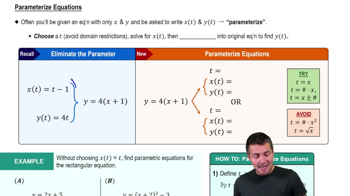
Parametric Equations
Parametric equations express the coordinates of points on a curve as functions of a parameter, often denoted as t. In this problem, x and y are given in terms of t, allowing the tracing of the curve as t varies over the interval [0, 2π]. Understanding how to interpret and plot these equations is essential for visualizing the curve.
Recommended video:
Parameterizing Equations
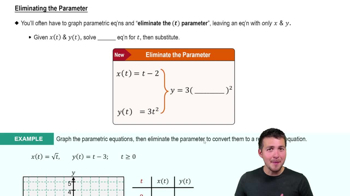
Eliminating the Parameter to Find a Rectangular Equation
To convert parametric equations into a single rectangular equation involving only x and y, the parameter t must be eliminated. This often involves using trigonometric identities, such as sin²t + cos²t = 1, to relate x and y directly. This step simplifies the curve's description and aids in further analysis.
Recommended video:
Eliminating the Parameter
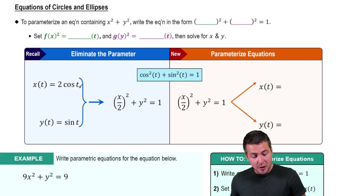
Graphing Ellipses
The given parametric equations describe an ellipse because x and y are scaled sine and cosine functions with different amplitudes. Recognizing this helps in sketching the curve accurately, knowing the ellipse's axes lengths correspond to the coefficients of sin t and cos t, here 4 and 3 respectively.
Recommended video:
Equations of Circles & Ellipses
Related Videos
Related Practice
Textbook Question
753
views