Advanced methods of trigonometry can be used to find the following exact value. sin 18° = (√5 - 1)/4 (See Hobson's A Treatise on Plane Trigonometry.) Use this value and identities to find each exact value. Support answers with calculator approximations if desired. cos 18°
Verified step by step guidance
1
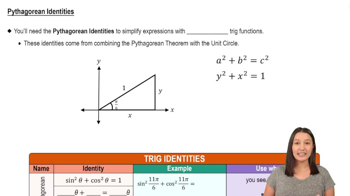
Recall the Pythagorean identity relating sine and cosine: \(\cos^2 \theta + \sin^2 \theta = 1\). This identity will help us find \(\cos 18^\circ\) once we know \(\sin 18^\circ\).
Substitute the given exact value of \(\sin 18^\circ = \frac{\sqrt{5} - 1}{4}\) into the identity: \(\cos^2 18^\circ = 1 - \sin^2 18^\circ\).
Calculate \(\sin^2 18^\circ\) by squaring the given expression: \(\left(\frac{\sqrt{5} - 1}{4}\right)^2 = \frac{(\sqrt{5} - 1)^2}{16}\).
Expand the numerator using the binomial formula: \((\sqrt{5} - 1)^2 = (\sqrt{5})^2 - 2 \times \sqrt{5} \times 1 + 1^2 = 5 - 2\sqrt{5} + 1 = 6 - 2\sqrt{5}\).
Substitute back to find \(\cos^2 18^\circ = 1 - \frac{6 - 2\sqrt{5}}{16}\). Simplify this expression to get \(\cos^2 18^\circ\), then take the positive square root (since \(18^\circ\) is in the first quadrant) to find \(\cos 18^\circ\).
Verified video answer for a similar problem:
This video solution was recommended by our tutors as helpful for the problem above
Play a video:
0 Comments
Key Concepts
Here are the essential concepts you must grasp in order to answer the question correctly.
Exact Values of Special Angles
Certain angles like 18°, 30°, 45°, 60°, and 90° have known exact trigonometric values expressed in radicals. For example, sin 18° = (√5 - 1)/4 is a special exact value derived from geometric constructions or advanced trigonometric methods. Understanding these exact values helps in finding related trigonometric functions without relying solely on decimal approximations.
The Pythagorean identity states that sin²θ + cos²θ = 1 for any angle θ. This fundamental relationship allows us to find one trigonometric function if the other is known exactly. For instance, knowing sin 18° enables calculation of cos 18° by rearranging the identity to cos 18° = √(1 - sin²18°).
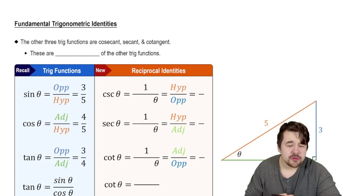
Trigonometric identities such as angle sum, difference, and double-angle formulas help relate different trigonometric values. Additionally, understanding the sign of cosine in the first quadrant (0° to 90°) ensures the correct positive root is chosen when calculating cos 18°. These identities and conventions are essential for accurate exact value determination.

 Verified step by step guidance
 04:39
04:39