In Exercises 1–4, u and v have the same direction. In each exercise: Find ||u||.
Verified step by step guidance
1
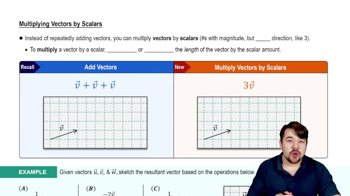
Understand that vectors \( \mathbf{u} \) and \( \mathbf{v} \) have the same direction means \( \mathbf{u} = k \mathbf{v} \) for some scalar \( k > 0 \).
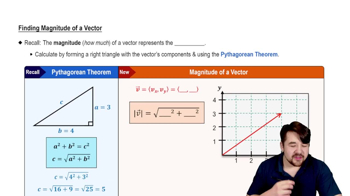
Recall that the magnitude (or norm) of a vector \( \mathbf{u} = (u_1, u_2, \ldots, u_n) \) is given by the formula:
\[ \\|\mathbf{u}\\| = \sqrt{u_1^2 + u_2^2 + \cdots + u_n^2} \]
Since \( \mathbf{u} \) and \( \mathbf{v} \) have the same direction, express \( \mathbf{u} \) as \( \mathbf{u} = k \mathbf{v} \), where \( k = \frac{\\|\mathbf{u}\\|}{\\|\mathbf{v}\\|} \).
Use the given information or values of \( \mathbf{v} \) and the scalar \( k \) (if provided) to find \( \\|\mathbf{u}\\| = |k| \times \\|\mathbf{v}\\| \).
Calculate the magnitude of \( \mathbf{v} \) using the formula in step 2, then multiply by \( |k| \) to find \( \\|\mathbf{u}\\| \).
Verified video answer for a similar problem:
This video solution was recommended by our tutors as helpful for the problem above
Video duration:
2m
Play a video:
0 Comments
Key Concepts
Here are the essential concepts you must grasp in order to answer the question correctly.
Vector Magnitude (Norm)
The magnitude or norm of a vector u, denoted ||u||, represents its length in space. It is calculated using the square root of the sum of the squares of its components. Understanding how to find ||u|| is essential for quantifying the size of a vector regardless of its direction.
Two vectors having the same direction means they are scalar multiples of each other, pointing along the same line. This concept helps simplify problems by relating one vector's magnitude to another's when their directions align.
Scalar multiplication involves multiplying a vector by a real number, changing its magnitude but not its direction. Recognizing this operation is key when vectors share direction, as one vector can be expressed as a scalar multiple of the other, aiding in finding magnitudes.