A balloonist is directly above a straight road 1.5 mi long that joins two villages. She finds that the town closer to her is at an angle of depression of 35°, and the farther town is at an angle of depression of 31°. How high above the ground is the balloon?
<IMAGE>
Verified step by step guidance
1
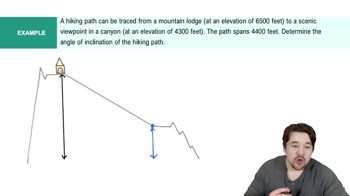
Draw a diagram to visualize the problem: represent the balloon at height \(h\) above the ground, and the two towns on the road separated by 1.5 miles. Label the distances from the balloon's vertical point to the closer town as \(x\), and to the farther town as \(x + 1.5\) miles.
Use the angles of depression to relate the height \(h\) and the horizontal distances. Recall that the angle of depression from the balloon to a town is equal to the angle between the horizontal line from the balloon and the line of sight downward to the town. Therefore, for the closer town, \(\tan(35^\circ) = \frac{h}{x}\), and for the farther town, \(\tan(31^\circ) = \frac{h}{x + 1.5}\).
Set up the two equations from the tangent relationships:
\(\tan(35^\circ) = \frac{h}{x}\)
\(\tan(31^\circ) = \frac{h}{x + 1.5}\)
Express \(h\) from both equations:
\(h = x \cdot \tan(35^\circ)\)
\(h = (x + 1.5) \cdot \tan(31^\circ)\)
Since both expressions equal \(h\), set them equal to each other and solve for \(x\):
\(x \cdot \tan(35^\circ) = (x + 1.5) \cdot \tan(31^\circ)\)
After finding \(x\), substitute back into one of the expressions for \(h\) to find the height of the balloon.
0 Comments
Key Concepts
Here are the essential concepts you must grasp in order to answer the question correctly.
Angle of Depression
The angle of depression is the angle formed between the horizontal line from the observer's eye and the line of sight downward to an object. In this problem, it helps relate the balloonist's height to the distances of the towns on the ground by forming right triangles.
Right triangle trigonometry uses sine, cosine, and tangent functions to relate angles and side lengths. Here, tangent is especially useful since it relates the height of the balloon (opposite side) to the horizontal distance to each town (adjacent side) via the angle of depression.
The two towns lie on a straight road 1.5 miles long, so the horizontal distances from the balloon to each town differ by 1.5 miles. This relationship allows setting up equations to solve for the balloon's height by combining the trigonometric expressions for both angles.