Find the exact value of s in the given interval that has the given circular function value. [ π , 3π/2] ; sec s = ―2√3/3
Verified step by step guidance
1
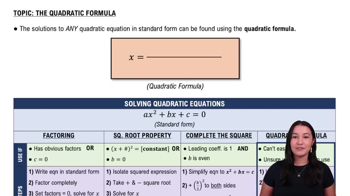
Recognize that the secant function, \( \sec(s) \), is the reciprocal of the cosine function, \( \cos(s) \). Therefore, \( \sec(s) = -\frac{2\sqrt{3}}{3} \) implies \( \cos(s) = -\frac{3}{2\sqrt{3}} \).
Simplify \( \cos(s) = -\frac{3}{2\sqrt{3}} \) by rationalizing the denominator to get \( \cos(s) = -\frac{\sqrt{3}}{2} \).
Identify the reference angle where \( \cos(\theta) = \frac{\sqrt{3}}{2} \). This angle is \( \theta = \frac{\pi}{6} \).
Since \( s \) is in the interval \([\pi, \frac{3\pi}{2}]\), and \( \cos(s) \) is negative, \( s \) must be in the third quadrant.
Determine the angle in the third quadrant by using the reference angle: \( s = \pi + \frac{\pi}{6} \).
Verified video answer for a similar problem:
This video solution was recommended by our tutors as helpful for the problem above
Play a video:
0 Comments
Key Concepts
Here are the essential concepts you must grasp in order to answer the question correctly.
Secant Function
The secant function, denoted as sec(s), is the reciprocal of the cosine function. It is defined as sec(s) = 1/cos(s). Understanding the secant function is crucial for solving problems involving circular functions, as it helps to determine the angle s when given a specific secant value.
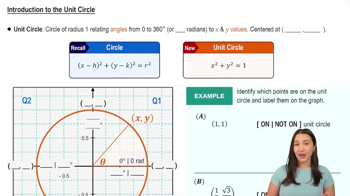
The unit circle is a circle with a radius of one centered at the origin of a coordinate plane. It is fundamental in trigonometry as it provides a geometric interpretation of the trigonometric functions. The angles and their corresponding sine, cosine, and secant values can be easily visualized on the unit circle, aiding in finding exact values for trigonometric equations.
Trigonometric functions have different signs in different quadrants of the unit circle. The interval [π, 3π/2] corresponds to the third quadrant, where both sine and cosine are negative. Recognizing the quadrant is essential for determining the correct angle that satisfies the given secant value, as it influences the sign and value of the trigonometric functions.