Given the equations of two lines and , determine whether the lines intersect. If they do, find the point of intersection.
Table of contents
- 0. Review of College Algebra4h 45m
- 1. Measuring Angles40m
- 2. Trigonometric Functions on Right Triangles2h 5m
- 3. Unit Circle1h 19m
- 4. Graphing Trigonometric Functions1h 19m
- 5. Inverse Trigonometric Functions and Basic Trigonometric Equations1h 41m
- 6. Trigonometric Identities and More Equations2h 34m
- 7. Non-Right Triangles1h 38m
- 8. Vectors2h 25m
- 9. Polar Equations2h 5m
- 10. Parametric Equations1h 6m
- 11. Graphing Complex Numbers1h 7m
0. Review of College Algebra
Solving Linear Equations
Problem 6
Textbook Question
CONCEPT PREVIEW Which one is not a linear equation? A. 5x + 7 (x - 1) = -3x B. 9x² - 4x + 3 = 0 C. 7x + 8x = 13 D. 0.04x - 0.08x = 0.40
Verified step by step guidance1
Recall that a linear equation in one variable x is an equation where the highest power of x is 1. This means the equation can be written in the form \(ax + b = 0\), where \(a\) and \(b\) are constants.
Examine option A: \$5x + 7 (x - 1) = -3x\(. First, expand the parentheses: \)5x + 7x - 7 = -3x$. Then combine like terms to check if the equation is linear.
Look at option B: \$9x^{2} - 4x + 3 = 0\(. Notice the term \)9x^{2}\(, which has \)x$ raised to the power of 2. This indicates the equation is quadratic, not linear.
Check option C: \$7x + 8x = 13\(. Combine like terms to get \)15x = 13\(, which is a linear equation since the highest power of \)x$ is 1.
Review option D: \$0.04x - 0.08x = 0.40\(. Combine like terms to get \)-0.04x = 0.40$, which is linear as well.
Verified video answer for a similar problem:This video solution was recommended by our tutors as helpful for the problem above
Video duration:
1mPlay a video:
0 Comments
Key Concepts
Here are the essential concepts you must grasp in order to answer the question correctly.
Definition of a Linear Equation
A linear equation is an algebraic equation in which each term is either a constant or the product of a constant and a single variable raised to the first power. It forms a straight line when graphed and does not include variables with exponents other than one.
Recommended video:
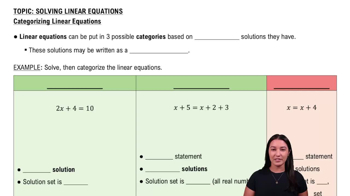
Categorizing Linear Equations
Identifying Non-Linear Terms
Non-linear terms include variables raised to powers other than one, such as squares or higher exponents, or variables multiplied together. Recognizing these terms helps distinguish linear equations from quadratic or other polynomial equations.
Recommended video:
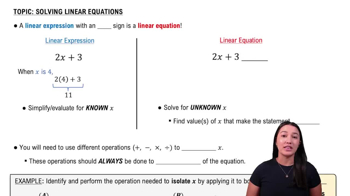
Solving Linear Equations
Simplifying and Comparing Equations
Simplifying each equation by expanding and combining like terms allows for easier identification of the equation's degree. This process helps determine whether the equation is linear or not by revealing the highest power of the variable.
Recommended video:
Simplifying Trig Expressions
Related Videos
Related Practice
Multiple Choice
74
views