Exercises 39β52 involve trigonometric equations quadratic in form. Solve each equation on the interval [0, 2π ). 4 cosΒ² x - 1 = 0
Table of contents
- 0. Review of College Algebra4h 45m
- 1. Measuring Angles40m
- 2. Trigonometric Functions on Right Triangles2h 5m
- 3. Unit Circle1h 19m
- 4. Graphing Trigonometric Functions1h 19m
- 5. Inverse Trigonometric Functions and Basic Trigonometric Equations1h 41m
- 6. Trigonometric Identities and More Equations2h 34m
- 7. Non-Right Triangles1h 38m
- 8. Vectors2h 25m
- 9. Polar Equations2h 5m
- 10. Parametric Equations1h 6m
- 11. Graphing Complex Numbers1h 7m
5. Inverse Trigonometric Functions and Basic Trigonometric Equations
Linear Trigonometric Equations
Problem 3.5.55
Textbook Question
In Exercises 53β62, solve each equation on the interval [0, 2π ). (2 cos x + β 3) (2 sin x + 1) = 0
Verified step by step guidance1
Recognize that the equation is a product of two factors equal to zero: \((2 \cos x + \sqrt{3})(2 \sin x + 1) = 0\). According to the zero product property, set each factor equal to zero separately.
Set the first factor equal to zero: \(2 \cos x + \sqrt{3} = 0\). Solve for \(\cos x\) to get \(\cos x = -\frac{\sqrt{3}}{2}\).
Set the second factor equal to zero: \(2 \sin x + 1 = 0\). Solve for \(\sin x\) to get \(\sin x = -\frac{1}{2}\).
Find all values of \(x\) in the interval \([0, 2\pi)\) that satisfy \(\cos x = -\frac{\sqrt{3}}{2}\). Recall the unit circle values where cosine equals this value and note the corresponding angles.
Find all values of \(x\) in the interval \([0, 2\pi)\) that satisfy \(\sin x = -\frac{1}{2}\). Use the unit circle to identify the angles where sine equals this value within the given interval.
Verified video answer for a similar problem:This video solution was recommended by our tutors as helpful for the problem above
Video duration:
10mPlay a video:
0 Comments
Key Concepts
Here are the essential concepts you must grasp in order to answer the question correctly.
Zero Product Property
This property states that if the product of two factors equals zero, then at least one of the factors must be zero. In the given equation, (2 cos x + β3)(2 sin x + 1) = 0, we set each factor equal to zero separately to find possible solutions for x.
Recommended video:
Introduction to Dot Product
Solving Basic Trigonometric Equations
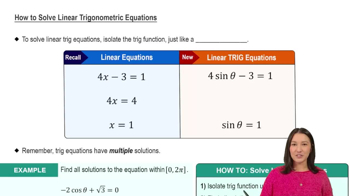
To solve equations like 2 cos x + β3 = 0 or 2 sin x + 1 = 0, isolate the trigonometric function and find the angle(s) x within the interval [0, 2Ο) that satisfy the equation. This involves using inverse sine or cosine functions and considering the unit circle.
Recommended video:
How to Solve Linear Trigonometric Equations
Interval Restriction and Unit Circle
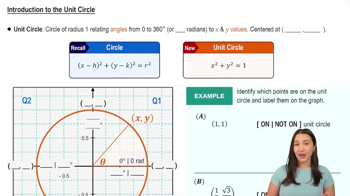
The solutions must lie within the interval [0, 2Ο), representing one full rotation on the unit circle. Understanding the unit circle helps identify all angles where sine or cosine take specific values, ensuring all valid solutions are found within the given domain.
Recommended video:
Introduction to the Unit Circle
Related Videos
Related Practice
Textbook Question
421
views