Table of contents
- 0. Review of College Algebra4h 45m
- 1. Measuring Angles40m
- 2. Trigonometric Functions on Right Triangles2h 5m
- 3. Unit Circle1h 19m
- 4. Graphing Trigonometric Functions1h 19m
- 5. Inverse Trigonometric Functions and Basic Trigonometric Equations1h 41m
- 6. Trigonometric Identities and More Equations2h 34m
- 7. Non-Right Triangles1h 38m
- 8. Vectors2h 25m
- 9. Polar Equations2h 5m
- 10. Parametric Equations1h 6m
- 11. Graphing Complex Numbers1h 7m
1. Measuring Angles
Complementary and Supplementary Angles
Problem 24
Textbook Question
Find the measure of each marked angle. See Example 2.
Verified step by step guidance1
Identify the given angles and the relationships between them in the diagram. Common relationships include complementary angles (sum to 90°), supplementary angles (sum to 180°), vertical angles (equal), and angles formed by parallel lines and a transversal (alternate interior, corresponding, etc.).
Write down the known angle measures and set variables for the unknown marked angles you need to find.
Use the appropriate angle relationships to set up equations. For example, if two angles are supplementary, write the equation as \(x + y = 180\); if they are complementary, write \(x + y = 90\); if they are vertical angles, set them equal: \(x = y\).
Solve the system of equations you have created to find the values of the unknown angles. This may involve substitution or elimination methods depending on the number of variables.
Check your answers by verifying that all angle relationships in the diagram are satisfied, ensuring the sum of angles around a point or on a straight line matches the expected total.
Verified video answer for a similar problem:This video solution was recommended by our tutors as helpful for the problem above
Video duration:
3mPlay a video:
0 Comments
Key Concepts
Here are the essential concepts you must grasp in order to answer the question correctly.
Angle Measurement Units
Understanding how angles are measured, typically in degrees or radians, is fundamental. Degrees divide a circle into 360 parts, while radians relate the angle to the radius of a circle. Knowing how to convert between these units is essential for solving angle problems.
Recommended video:
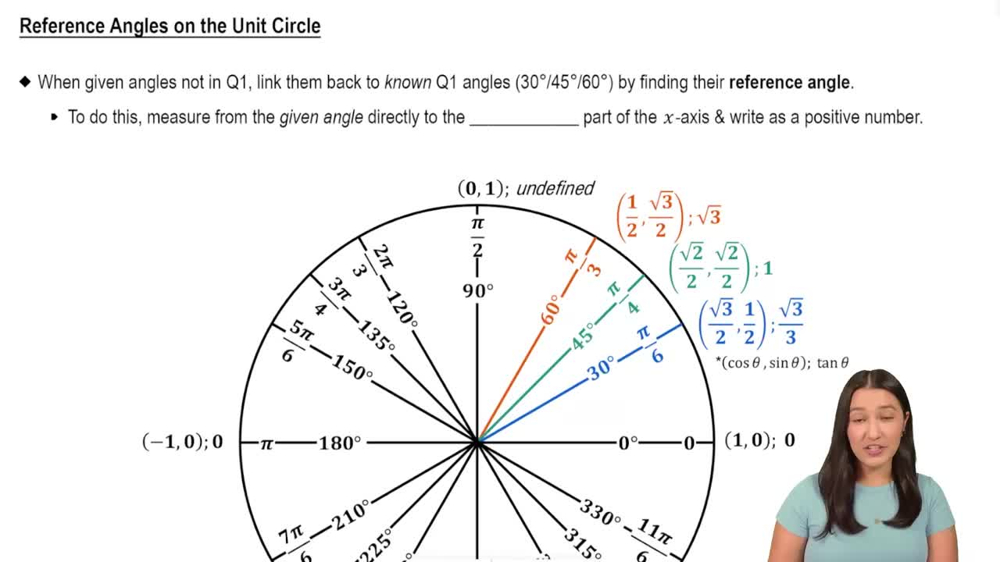
Reference Angles on the Unit Circle
Properties of Angles
Familiarity with angle properties such as complementary, supplementary, vertical, and adjacent angles helps in determining unknown angle measures. For example, supplementary angles sum to 180°, and vertical angles are equal, which are often used to find missing angles.
Recommended video:
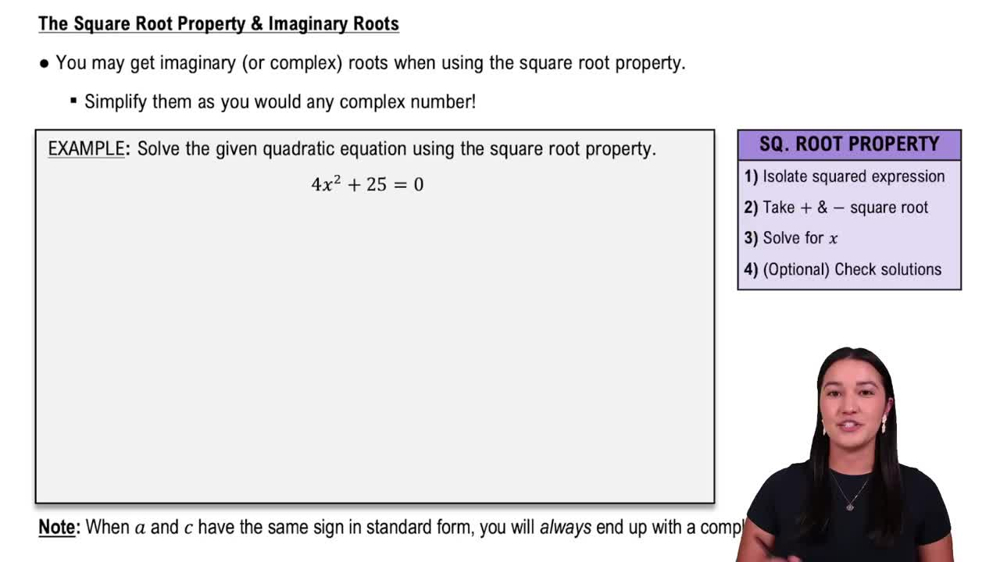
Imaginary Roots with the Square Root Property
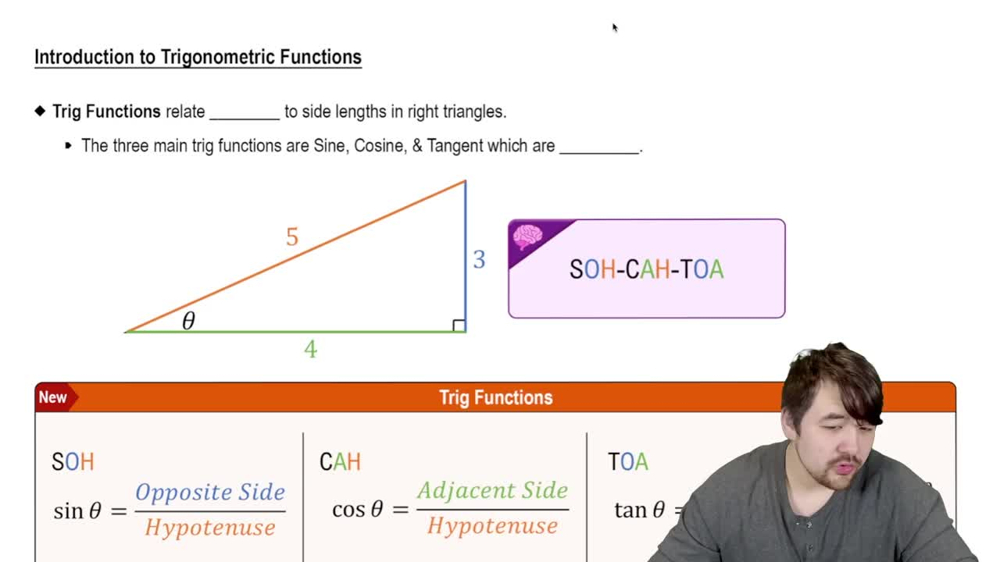
Trigonometric Ratios and Functions
Trigonometric functions like sine, cosine, and tangent relate angles to side lengths in right triangles. These ratios are crucial for calculating unknown angles when side lengths are known, or vice versa, and are often applied in problems involving marked angles.
Recommended video:
Introduction to Trigonometric Functions
Related Videos
Related Practice
Textbook Question
Solar Eclipse on Mars (Refer to Exercise 69.) The sun's distance from the surface of Mars is approximately 142,000,000 mi. One of Mars' two moons, Phobos, has a maximum diameter of 17.4 mi. (Data fromThe World Almanac and Book of Facts.) b. Phobos is approximately 5800 mi from Mars. Is it possible for Phobos to cause a total eclipse on Mars?
430
views