Solve each equation (x in radians and θ in degrees) for all exact solutions where appropriate. Round approximate answers in radians to four decimal places and approximate answers in degrees to the nearest tenth. Write answers using the least possible nonnegative angle measures. 2 cos² x + cos x ― 1 = 0
Verified step by step guidance
1
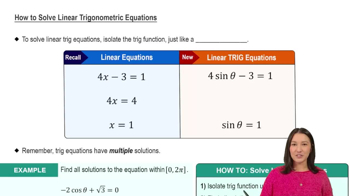
Recognize that the equation is a quadratic in terms of \( \cos x \). Let \( y = \cos x \), so the equation becomes \( 2y^2 + y - 1 = 0 \).
Use the quadratic formula to solve for \( y \): \( y = \frac{-b \pm \sqrt{b^2 - 4ac}}{2a} \), where \( a = 2 \), \( b = 1 \), and \( c = -1 \).
Calculate the discriminant \( \Delta = b^2 - 4ac = 1^2 - 4 \times 2 \times (-1) \) and then find the two possible values for \( y = \cos x \).
For each value of \( \cos x \), determine the corresponding values of \( x \) in radians by using the inverse cosine function \( x = \arccos(y) \). Remember to find all solutions within the domain by considering the unit circle symmetry.
Express the solutions for \( x \) as the least possible nonnegative angles in radians, rounding approximate values to four decimal places. If needed, convert these radian values to degrees and round to the nearest tenth.
Verified video answer for a similar problem:
This video solution was recommended by our tutors as helpful for the problem above
Video duration:
7m
Play a video:
0 Comments
Key Concepts
Here are the essential concepts you must grasp in order to answer the question correctly.
Solving Quadratic Trigonometric Equations
This involves treating trigonometric equations like algebraic quadratics by substituting a trigonometric function (e.g., cos x) with a variable. After factoring or using the quadratic formula, solutions for the trigonometric function are found, which are then used to determine the angle values.
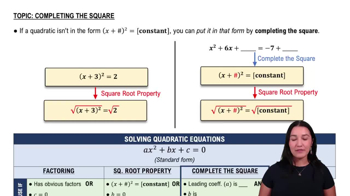
Solving Quadratic Equations by Completing the Square
General and Principal Solutions of Trigonometric Equations
Trigonometric equations often have infinitely many solutions due to periodicity. The principal solution is the smallest nonnegative angle, while the general solution includes all angles differing by full periods (e.g., 2π radians or 360°). Understanding this helps list all exact solutions.
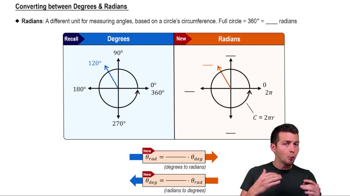
Converting Between Radians and Degrees and Rounding
Angles can be expressed in radians or degrees, and converting between them uses the relation 180° = π radians. After finding exact solutions, approximate answers may be required, rounded to specified decimal places or nearest tenths, ensuring clarity and precision in final answers.