Distance between Cities Find the distance in kilometers between each pair of cities, assuming they lie on the same north-south line. Assume the radius of Earth is 6400 km. See Example 2. Farmersville, California, 36° N, and Penticton, British Columbia, 49° N
Verified step by step guidance
1
Identify the latitudes of the two cities: Farmersville at 36° N and Penticton at 49° N. Since they lie on the same north-south line, the difference in latitude will determine the distance between them along the Earth's surface.
Calculate the difference in latitude: \(\Delta \theta = 49^\circ - 36^\circ = 13^\circ\).
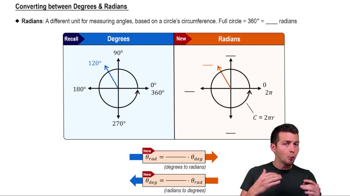
Convert the latitude difference from degrees to radians because trigonometric calculations on a circle use radians. Use the conversion formula: \(\text{radians} = \Delta \theta \times \frac{\pi}{180}\).
Use the formula for arc length on a circle to find the distance between the two cities: \(\text{distance} = R \times \Delta \theta_{\text{radians}}\), where \(R = 6400\) km is the radius of the Earth.
Substitute the values into the formula and simplify to express the distance in kilometers. This will give the distance along the Earth's surface between Farmersville and Penticton.
Verified video answer for a similar problem:
This video solution was recommended by our tutors as helpful for the problem above
Play a video:
0 Comments
Key Concepts
Here are the essential concepts you must grasp in order to answer the question correctly.
Latitude and Angular Distance
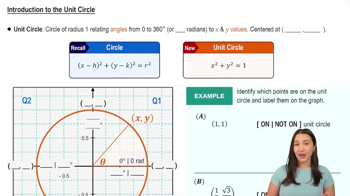
Latitude measures how far north or south a location is from the Equator, expressed in degrees. The angular distance between two points on the same meridian is the difference in their latitudes, which is essential for calculating the surface distance along a north-south line.
The distance between two points on a circle's circumference can be found by multiplying the radius by the central angle in radians. This formula, arc length = radius × angle, allows conversion of angular differences (in degrees) into linear distances on Earth's surface.
Since trigonometric calculations require angles in radians, converting degrees to radians is necessary. The conversion is done by multiplying degrees by π/180, enabling the use of the arc length formula to find distances on Earth's curved surface.