A pilot is flying at 168 mph. She wants her flight path to be on a bearing of 57° 40′. A wind is blowing from the south at 27.1 mph. Find the bearing she should fly, and find the plane's ground speed.
Table of contents
- 0. Review of College Algebra4h 45m
- 1. Measuring Angles40m
- 2. Trigonometric Functions on Right Triangles2h 5m
- 3. Unit Circle1h 19m
- 4. Graphing Trigonometric Functions1h 19m
- 5. Inverse Trigonometric Functions and Basic Trigonometric Equations1h 41m
- 6. Trigonometric Identities and More Equations2h 34m
- 7. Non-Right Triangles1h 38m
- 8. Vectors2h 25m
- 9. Polar Equations2h 5m
- 10. Parametric Equations1h 6m
- 11. Graphing Complex Numbers1h 7m
8. Vectors
Geometric Vectors
Problem 51
Textbook Question
Find the force required to keep a 75-lb sled from sliding down an incline that makes an angle of 27° with the horizontal. (Assume there is no friction.)
Verified step by step guidance1
Identify the forces acting on the sled: the weight (gravity) acting vertically downward and the force required to keep the sled from sliding down the incline, which acts parallel to the incline surface.
Resolve the weight of the sled into two components: one perpendicular to the incline and one parallel to the incline. The component parallel to the incline causes the sled to slide down.
Use the formula for the component of weight parallel to the incline: \(W_{\parallel} = W \times \sin(\theta)\), where \(W\) is the weight (75 lb) and \(\theta\) is the angle of the incline (27°).
Since there is no friction, the force required to keep the sled from sliding is equal in magnitude and opposite in direction to the parallel component of the weight, so \(F = W_{\parallel}\).
Substitute the known values into the equation \(F = 75 \times \sin(27^\circ)\) to express the force required to keep the sled stationary on the incline.
Verified video answer for a similar problem:This video solution was recommended by our tutors as helpful for the problem above
Play a video:
0 Comments
Key Concepts
Here are the essential concepts you must grasp in order to answer the question correctly.
Resolving Forces on an Inclined Plane
When an object rests on an inclined plane, its weight can be resolved into two components: one perpendicular to the plane and one parallel to it. The parallel component causes the object to slide down, calculated as weight multiplied by the sine of the incline angle.
Recommended video:
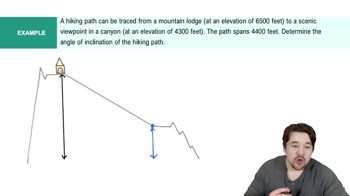
Example 2
Force Required to Prevent Sliding
To keep the sled from sliding, an external force must counteract the component of weight pulling it down the slope. This force equals the parallel component of the weight, acting up the incline to maintain equilibrium.
Recommended video:
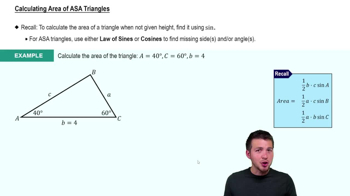
Calculating Area of ASA Triangles
Trigonometric Functions in Force Analysis
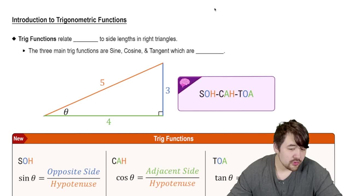
Trigonometric functions like sine and cosine relate the angle of the incline to the components of forces. Specifically, sine is used to find the component of weight parallel to the incline, essential for calculating the force needed to prevent sliding.
Recommended video:
Introduction to Trigonometric Functions
Related Videos
Related Practice
Textbook Question
736
views