Find values of the sine and cosine functions for each angle measure.
θ, given cos 2θ = 2/3 and 90° < θ <180°
Verified step by step guidance
1
Identify the given information: \( \cos 2\theta = \frac{2}{3} \) and the angle \( \theta \) lies in the second quadrant, i.e., \( 90^\circ < \theta < 180^\circ \).
Recall the double-angle identity for cosine: \( \cos 2\theta = 2\cos^2 \theta - 1 \). Use this to express \( \cos^2 \theta \) in terms of \( \cos 2\theta \).
Substitute \( \cos 2\theta = \frac{2}{3} \) into the identity and solve for \( \cos^2 \theta \):
\[ \frac{2}{3} = 2\cos^2 \theta - 1 \]
Rearrange to find \( \cos^2 \theta \).
Determine \( \cos \theta \) by taking the square root of \( \cos^2 \theta \). Since \( \theta \) is in the second quadrant, \( \cos \theta \) is negative.
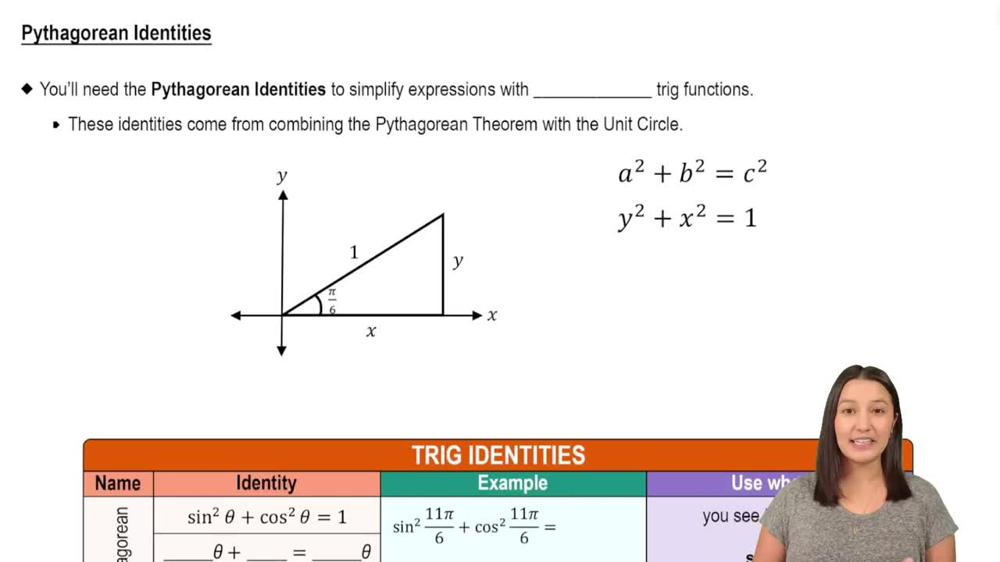
Use the Pythagorean identity \( \sin^2 \theta + \cos^2 \theta = 1 \) to find \( \sin \theta \). Since \( \theta \) is in the second quadrant, \( \sin \theta \) is positive.
Verified video answer for a similar problem:
This video solution was recommended by our tutors as helpful for the problem above
Play a video:
0 Comments
Key Concepts
Here are the essential concepts you must grasp in order to answer the question correctly.
Double-Angle Identity for Cosine
The double-angle identity relates cos 2θ to cos θ and sin θ, typically expressed as cos 2θ = cos²θ - sin²θ or cos 2θ = 2cos²θ - 1. This identity allows us to find the values of sine and cosine for θ when cos 2θ is known.
Knowing the quadrant of angle θ is crucial because it determines the signs of sine and cosine. Since 90° < θ < 180°, θ lies in the second quadrant where sine is positive and cosine is negative, guiding the correct sign assignment for the values.
The Pythagorean identity, sin²θ + cos²θ = 1, connects sine and cosine values. After finding one value using the double-angle formula, this identity helps calculate the other, ensuring the sine and cosine values satisfy this fundamental relationship.

 Verified step by step guidance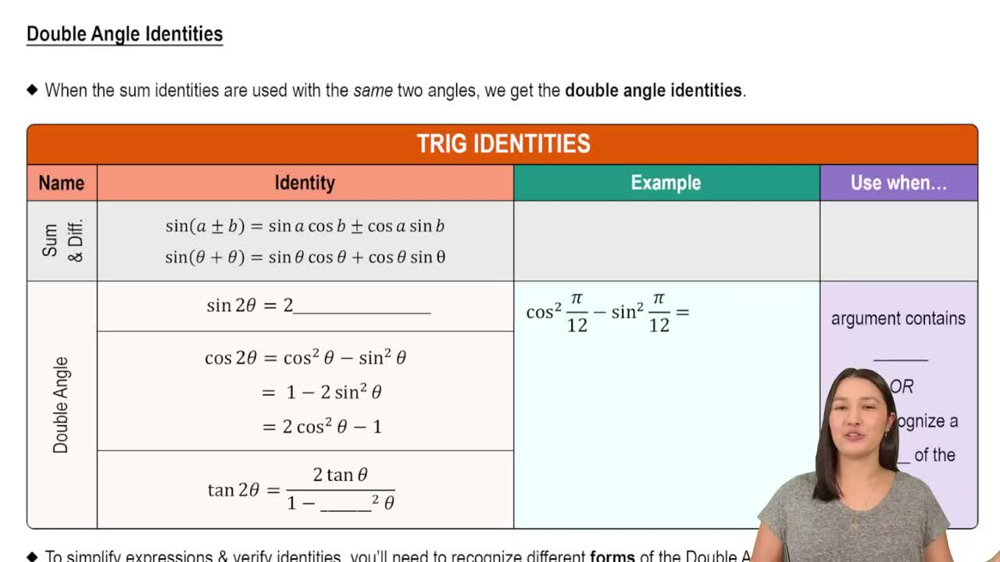
 05:06
05:06