In Exercises 61–86, use reference angles to find the exact value of each expression. Do not use a calculator. cot(7𝜋/4)
Table of contents
- 0. Review of College Algebra4h 45m
- 1. Measuring Angles40m
- 2. Trigonometric Functions on Right Triangles2h 5m
- 3. Unit Circle1h 19m
- 4. Graphing Trigonometric Functions1h 19m
- 5. Inverse Trigonometric Functions and Basic Trigonometric Equations1h 41m
- 6. Trigonometric Identities and More Equations2h 34m
- 7. Non-Right Triangles1h 38m
- 8. Vectors2h 25m
- 9. Polar Equations2h 5m
- 10. Parametric Equations1h 6m
- 11. Graphing Complex Numbers1h 7m
3. Unit Circle
Reference Angles
Problem 77
Textbook Question
Use reference angles to find the exact value of each expression. Do not use a calculator. sec 495°
Verified step by step guidance1
First, recognize that the angle given is 495°, which is greater than 360°. To find its reference angle, reduce it by subtracting 360° to find an equivalent angle within one full rotation: \$495° - 360° = 135°$.
Next, determine the quadrant in which the angle 135° lies. Since 135° is between 90° and 180°, it lies in the second quadrant.
Recall that the secant function is the reciprocal of the cosine function: \(\sec \theta = \frac{1}{\cos \theta}\). The sign of secant depends on the sign of cosine in the quadrant of the angle.
Find the reference angle for 135°, which is the acute angle it makes with the x-axis. The reference angle \(\alpha\) is \$180° - 135° = 45°$.
Use the reference angle to find \(\cos 45°\), which is \(\frac{\sqrt{2}}{2}\). Since cosine is negative in the second quadrant, \(\cos 135° = -\frac{\sqrt{2}}{2}\). Therefore, \(\sec 135° = \frac{1}{\cos 135°} = -\sqrt{2}\). This value is the same for \(\sec 495°\) because they are coterminal angles.
Verified video answer for a similar problem:This video solution was recommended by our tutors as helpful for the problem above
Video duration:
4mPlay a video:
0 Comments
Key Concepts
Here are the essential concepts you must grasp in order to answer the question correctly.
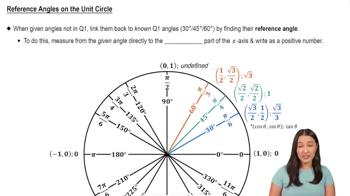
Reference Angles
A reference angle is the acute angle formed between the terminal side of an angle and the x-axis. It helps simplify trigonometric calculations by relating angles greater than 90° to their acute counterparts, allowing the use of known exact values.
Recommended video:
Reference Angles on the Unit Circle
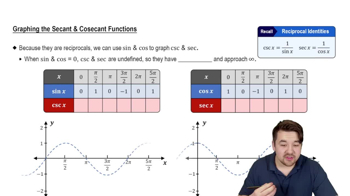
Secant Function and Its Relationship to Cosine
The secant function, sec(θ), is the reciprocal of the cosine function: sec(θ) = 1/cos(θ). Understanding this relationship is essential for finding exact values, especially when using reference angles to determine cosine values first.
Recommended video:
Graphs of Secant and Cosecant Functions
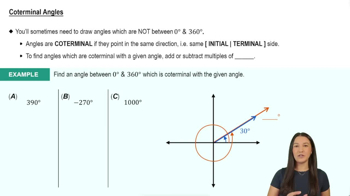
Angle Reduction Using Coterminal Angles
Angles greater than 360° can be reduced by subtracting multiples of 360° to find a coterminal angle within the standard 0°–360° range. This simplification is crucial for applying reference angles and known trigonometric values.
Recommended video:
Coterminal Angles
Related Videos
Related Practice
Textbook Question
582
views