Find the remaining five trigonometric functions of θ. csc θ = -5/2, θ in quadrant III
Verified step by step guidance
1
Recall that the cosecant function is the reciprocal of the sine function, so we can find \(\sin \theta\) by taking the reciprocal of \(\csc \theta\). Write this as \(\sin \theta = \frac{1}{\csc \theta}\).
Calculate \(\sin \theta\) using the given value \(\csc \theta = -\frac{5}{2}\), so \(\sin \theta = -\frac{2}{5}\). Remember the sign is negative because \(\csc \theta\) is negative in quadrant III.
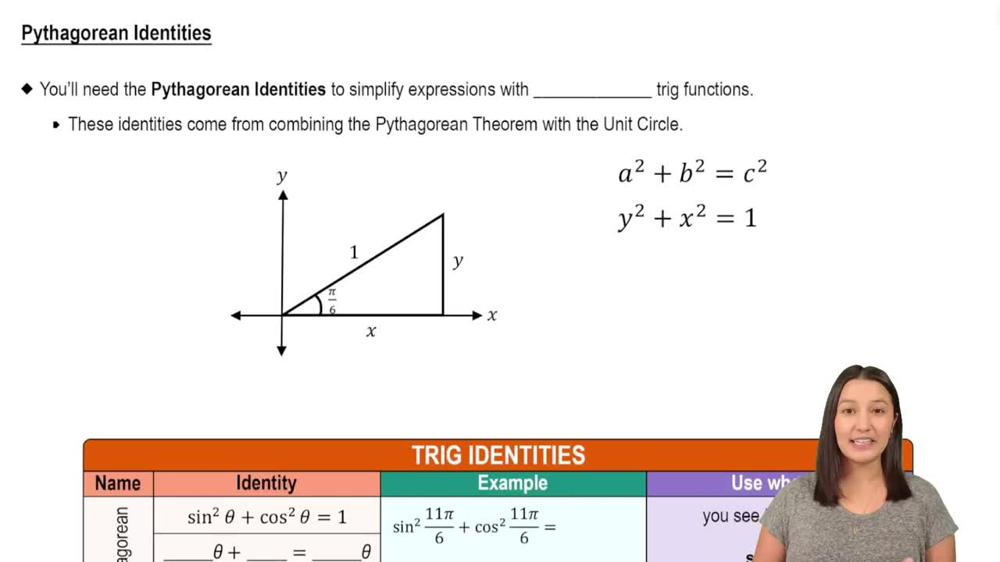
Use the Pythagorean identity \(\sin^2 \theta + \cos^2 \theta = 1\) to find \(\cos \theta\). Substitute \(\sin \theta = -\frac{2}{5}\) and solve for \(\cos \theta\).
Determine the sign of \(\cos \theta\) in quadrant III. Since cosine is negative in quadrant III, choose the negative root for \(\cos \theta\).
Find the remaining trigonometric functions using the definitions: \(\tan \theta = \frac{\sin \theta}{\cos \theta}\), \(\sec \theta = \frac{1}{\cos \theta}\), and \(\cot \theta = \frac{1}{\tan \theta}\). Use the values of \(\sin \theta\) and \(\cos \theta\) found in previous steps.
Verified video answer for a similar problem:
This video solution was recommended by our tutors as helpful for the problem above
Play a video:
0 Comments
Key Concepts
Here are the essential concepts you must grasp in order to answer the question correctly.
Reciprocal Trigonometric Functions
Each trigonometric function has a reciprocal counterpart: sine and cosecant, cosine and secant, tangent and cotangent. Knowing one function allows you to find its reciprocal by taking the inverse (e.g., csc θ = 1/sin θ). This relationship is essential for determining missing functions when one is given.
The sign of trigonometric functions depends on the quadrant of the angle θ. In quadrant III, both sine and cosine are negative, while tangent is positive. Understanding these sign rules helps correctly assign positive or negative values to the functions when calculating them.
The Pythagorean identity, sin²θ + cos²θ = 1, links sine and cosine values. Given one function, you can use this identity to find the other. This is crucial for finding all trigonometric functions when only one is known, especially when combined with quadrant sign information.

 Verified step by step guidance
 6:04
6:04