One boat pulls a barge with a force of 100 newtons. Another boat pulls the barge at an angle of 45° to the first force, with a force of 200 newtons. Find the resultant force acting on the barge, to the nearest unit, and the angle between the resultant and the first boat, to the nearest tenth.
Table of contents
- 0. Review of College Algebra4h 45m
- 1. Measuring Angles40m
- 2. Trigonometric Functions on Right Triangles2h 5m
- 3. Unit Circle1h 19m
- 4. Graphing Trigonometric Functions1h 19m
- 5. Inverse Trigonometric Functions and Basic Trigonometric Equations1h 41m
- 6. Trigonometric Identities and More Equations2h 34m
- 7. Non-Right Triangles1h 38m
- 8. Vectors2h 25m
- 9. Polar Equations2h 5m
- 10. Parametric Equations1h 6m
- 11. Graphing Complex Numbers1h 7m
8. Vectors
Geometric Vectors
Problem 23
Textbook Question
In Exercises 21–38, let u = 2i - 5j, v = -3i + 7j, and w = -i - 6j. Find each specified vector or scalar.
u - v
Verified step by step guidance1
Identify the given vectors: \( \mathbf{u} = 2\mathbf{i} - 5\mathbf{j} \) and \( \mathbf{v} = -3\mathbf{i} + 7\mathbf{j} \).
Recall that vector subtraction \( \mathbf{u} - \mathbf{v} \) is performed by subtracting the corresponding components of \( \mathbf{v} \) from \( \mathbf{u} \).
Subtract the \( \mathbf{i} \)-components: \( 2 - (-3) = 2 + 3 \).
Subtract the \( \mathbf{j} \)-components: \( -5 - 7 = -5 - 7 \).
Write the resulting vector as \( (2 + 3)\mathbf{i} + (-5 - 7)\mathbf{j} \), which is the vector \( \mathbf{u} - \mathbf{v} \).
Verified video answer for a similar problem:This video solution was recommended by our tutors as helpful for the problem above
Video duration:
1mPlay a video:
0 Comments
Key Concepts
Here are the essential concepts you must grasp in order to answer the question correctly.
Vector Representation in Component Form
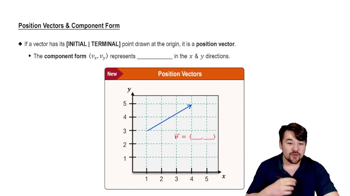
Vectors in two dimensions can be expressed as components along the i (x-axis) and j (y-axis) unit vectors. For example, u = 2i - 5j means the vector has an x-component of 2 and a y-component of -5. Understanding this form allows for straightforward vector operations like addition and subtraction.
Recommended video:
Position Vectors & Component Form
Vector Subtraction
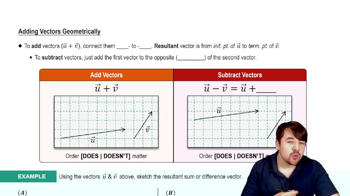
Vector subtraction involves subtracting corresponding components of two vectors. For vectors u and v, u - v is found by subtracting the x-components and y-components separately, resulting in a new vector. This operation is essential for finding the difference or relative position between vectors.
Recommended video:
Adding Vectors Geometrically
Unit Vectors i and j
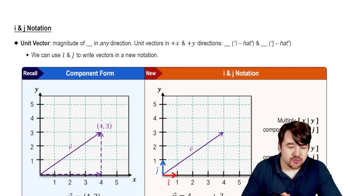
Unit vectors i and j represent the standard basis vectors along the x and y axes, respectively. They have a magnitude of one and direction along their respective axes. Expressing vectors in terms of i and j simplifies calculations and visualization in the plane.
Recommended video:
i & j Notation
Related Videos
Related Practice
Textbook Question
677
views