Identify all the given angles and the relationships between them, such as complementary, supplementary, vertical, or corresponding angles.
Use the fact that the sum of angles on a straight line is \(180^\circ\) and the sum of angles in a triangle is \(180^\circ\) to set up equations involving the marked angles.
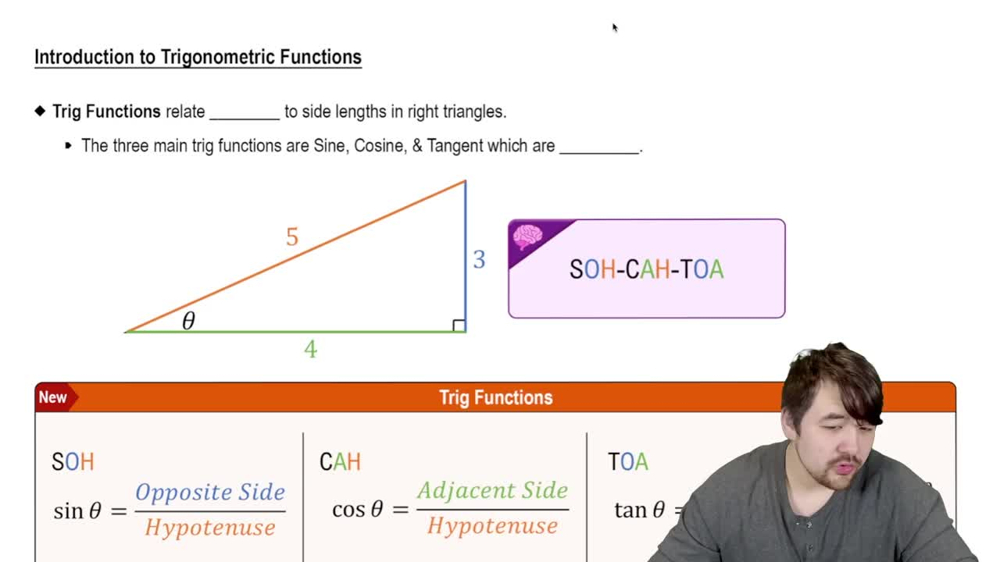
Apply trigonometric identities or properties if the problem involves right triangles or specific angle measures, such as \(\sin\), \(\cos\), or \(\tan\) ratios.
Write down the equations based on the relationships and solve for the unknown angles step-by-step, isolating one variable at a time.
Check your answers by verifying that all angle measures satisfy the original angle relationships and sum conditions.
Verified video answer for a similar problem:
This video solution was recommended by our tutors as helpful for the problem above
Video duration:
4m
Play a video:
0 Comments
Key Concepts
Here are the essential concepts you must grasp in order to answer the question correctly.
Angle Measurement
Angle measurement quantifies the rotation between two intersecting lines or rays, typically expressed in degrees or radians. Understanding how to read and interpret angle measures is fundamental to solving problems involving marked angles.
Key properties such as complementary, supplementary, vertical, and adjacent angles help determine unknown angle measures. Recognizing these relationships allows for setting up equations to find the values of marked angles.
Trigonometric ratios (sine, cosine, tangent) relate the angles of a triangle to the lengths of its sides. These functions are essential when angles are not directly measurable but can be found using side lengths or other given information.

 4:05 minutes
 Verified step by step guidance
 5:31
5:31