Find exact values or expressions for sin A, cos A, and tan A. See Example 1.
Verified step by step guidance
1
Identify the given information about angle A from the problem or diagram, such as the lengths of sides in a right triangle or the coordinates on the unit circle.
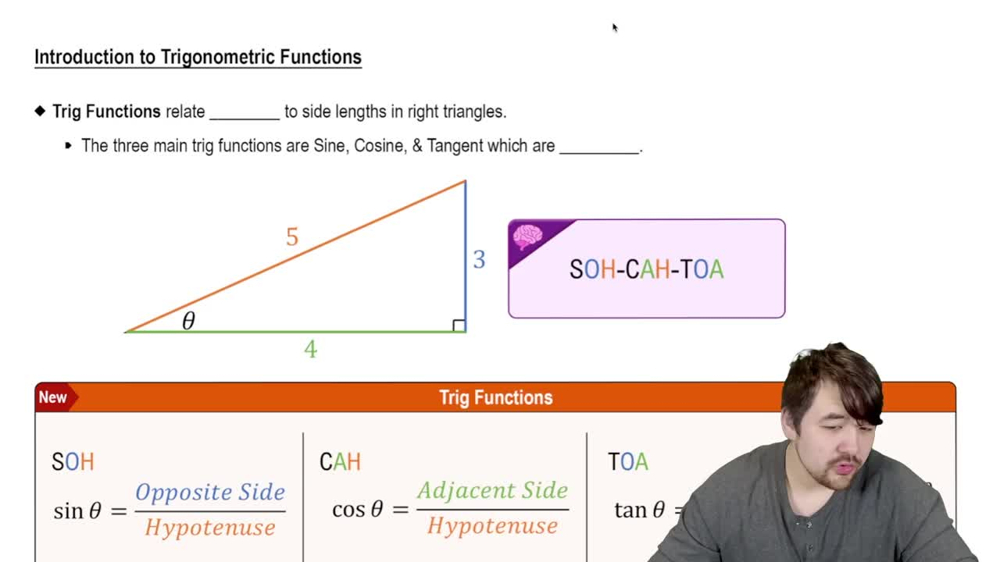
Recall the definitions of the trigonometric functions in a right triangle: \(\sin A = \frac{\text{opposite}}{\text{hypotenuse}}\), \(\cos A = \frac{\text{adjacent}}{\text{hypotenuse}}\), and \(\tan A = \frac{\text{opposite}}{\text{adjacent}}\).
If the problem involves a right triangle, use the Pythagorean theorem \(a^2 + b^2 = c^2\) to find any missing side lengths needed to compute the ratios for sine, cosine, and tangent.
Substitute the known side lengths into the definitions to write expressions for \(\sin A\), \(\cos A\), and \(\tan A\) in terms of these lengths.
Simplify the expressions if possible, such as reducing fractions or rationalizing denominators, to find the exact values or expressions for \(\sin A\), \(\cos A\), and \(\tan A\).
Verified video answer for a similar problem:
This video solution was recommended by our tutors as helpful for the problem above
Video duration:
3m
Play a video:
0 Comments
Key Concepts
Here are the essential concepts you must grasp in order to answer the question correctly.
Trigonometric Ratios
Trigonometric ratios—sine, cosine, and tangent—relate the angles of a right triangle to the ratios of its sides. Specifically, sin A = opposite/hypotenuse, cos A = adjacent/hypotenuse, and tan A = opposite/adjacent. Understanding these definitions is essential for finding exact values of these functions.
Certain angles like 0°, 30°, 45°, 60°, and 90° have well-known exact trigonometric values derived from special triangles or the unit circle. Recognizing these angles and their sine, cosine, and tangent values allows for precise calculation without a calculator.
Using example problems helps illustrate the method to find sin A, cos A, and tan A, often involving drawing triangles, applying definitions, or using identities. Reviewing Example 1 provides a step-by-step approach to solving similar trigonometric questions.

 3:24 minutes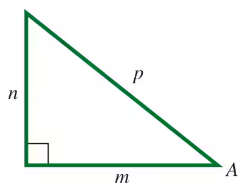
 Verified step by step guidance
 6:04
6:04