Find the exact value of each real number y if it exists. Do not use a calculator. y = tan⁻¹ 1
Verified step by step guidance
1
Recognize that the expression \(y = \tan^{-1} 1\) asks for the angle \(y\) whose tangent value is 1.
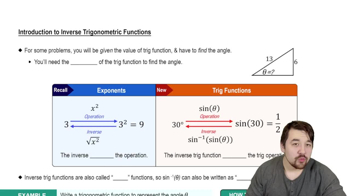
Recall the definition of the inverse tangent function: \(\tan^{-1} x\) gives the angle \(\theta\) such that \(\tan \theta = x\) and \(\theta\) lies within the principal range \(\left(-\frac{\pi}{2}, \frac{\pi}{2}\right)\).
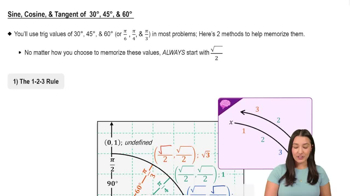
Identify the angle within the principal range where the tangent is 1. From the unit circle or common trigonometric values, \(\tan \frac{\pi}{4} = 1\).
Conclude that the exact value of \(y\) is the angle \(\frac{\pi}{4}\), since it satisfies \(\tan y = 1\) and lies in the principal range of \(\tan^{-1}\).
Therefore, the solution is \(y = \frac{\pi}{4}\).
Verified video answer for a similar problem:
This video solution was recommended by our tutors as helpful for the problem above
Play a video:
0 Comments
Key Concepts
Here are the essential concepts you must grasp in order to answer the question correctly.
Inverse Tangent Function (arctan)
The inverse tangent function, denoted as tan⁻¹ or arctan, returns the angle whose tangent is a given number. It maps real numbers to angles typically in the range (-π/2, π/2). Understanding this function helps find the angle y such that tan(y) equals the given value.
Certain angles have well-known tangent values, such as tan(π/4) = 1. Recognizing these special angles allows you to find exact values without a calculator by matching the given tangent value to a standard angle.
Range and Principal Values of Inverse Trigonometric Functions
Inverse trig functions have restricted output ranges to ensure they are functions. For arctan, the principal value lies between -π/2 and π/2. This restriction ensures a unique solution for y = tan⁻¹(1), which is important for determining the exact angle.

 Verified step by step guidance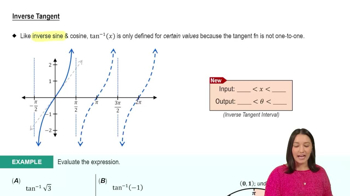
 3:17
3:17