Evaluate each expression.
Table of contents
- 0. Review of College Algebra4h 45m
- 1. Measuring Angles40m
- 2. Trigonometric Functions on Right Triangles2h 5m
- 3. Unit Circle1h 19m
- 4. Graphing Trigonometric Functions1h 19m
- 5. Inverse Trigonometric Functions and Basic Trigonometric Equations1h 41m
- 6. Trigonometric Identities and More Equations2h 34m
- 7. Non-Right Triangles1h 38m
- 8. Vectors2h 25m
- 9. Polar Equations2h 5m
- 10. Parametric Equations1h 6m
- 11. Graphing Complex Numbers1h 7m
3. Unit Circle
Reciprocal Trigonometric Functions on the Unit Circle
Problem 11
Textbook Question
In Exercises 5β18, the unit circle has been divided into twelve equal arcs, corresponding to t-values of
0, π, π, π, 2π, 5π, π, 7π, 4π, 3π, 5π, 11π, and 2π.
6 3 2 3 6 6 3 2 3 6
Use the (x,y) coordinates in the figure to find the value of each trigonometric function at the indicated real number, t, or state that the expression is undefined.
<IMAGE>
In Exercises 11β18, continue to refer to the figure at the bottom of the previous page.
csc 7π/6
Verified step by step guidance1
Identify the angle given: \(t = \frac{7\pi}{6}\). This angle is in radians and corresponds to a point on the unit circle.
Recall that the cosecant function is the reciprocal of the sine function, so \(\csc t = \frac{1}{\sin t}\).
Locate the coordinates of the point on the unit circle corresponding to \(t = \frac{7\pi}{6}\). The coordinates are \((x, y) = (\cos t, \sin t)\).
Find the \(y\)-coordinate (which is \(\sin \frac{7\pi}{6}\)) from the unit circle. This value will be used to calculate \(\csc \frac{7\pi}{6}\).
Calculate \(\csc \frac{7\pi}{6}\) by taking the reciprocal of \(\sin \frac{7\pi}{6}\), i.e., \(\csc \frac{7\pi}{6} = \frac{1}{\sin \frac{7\pi}{6}}\). If \(\sin \frac{7\pi}{6} = 0\), then \(\csc \frac{7\pi}{6}\) is undefined.
Verified video answer for a similar problem:This video solution was recommended by our tutors as helpful for the problem above
Video duration:
3mPlay a video:
0 Comments
Key Concepts
Here are the essential concepts you must grasp in order to answer the question correctly.
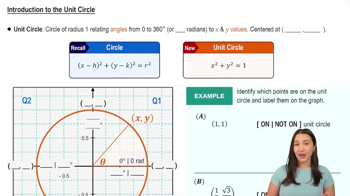
Unit Circle and Radian Measure
The unit circle is a circle with radius 1 centered at the origin of the coordinate plane. Angles on the unit circle are measured in radians, where one full rotation equals 2Ο radians. Understanding how to locate an angle t on the unit circle is essential for determining the corresponding coordinates (x, y) that represent cosine and sine values.
Recommended video:
Introduction to the Unit Circle
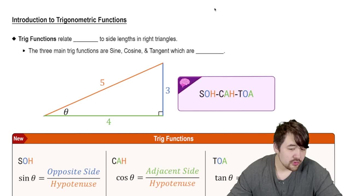
Trigonometric Functions and Their Coordinates
On the unit circle, the x-coordinate corresponds to cos(t) and the y-coordinate corresponds to sin(t). Other trigonometric functions like cosecant (csc t) are defined in terms of sine, with csc t = 1/sin t. Knowing how to use the coordinates to find these values is crucial, especially to identify when functions are undefined (e.g., when sin t = 0).
Recommended video:
Introduction to Trigonometric Functions
Evaluating Trigonometric Functions at Specific Angles
To evaluate functions like csc(7Ο/6), first locate the angle 7Ο/6 on the unit circle, find the sine value from the y-coordinate, and then compute the reciprocal for cosecant. Recognizing common reference angles and their sine values helps simplify this process and determine if the function is defined or undefined.
Recommended video:
Evaluate Composite Functions - Special Cases
Related Videos
Related Practice
Multiple Choice
457
views
