Find the exact value of the variables in each figure.
Verified step by step guidance
1
Identify the given information in the figure, such as known side lengths, angles, or relationships between angles (e.g., complementary, supplementary, or equal angles).
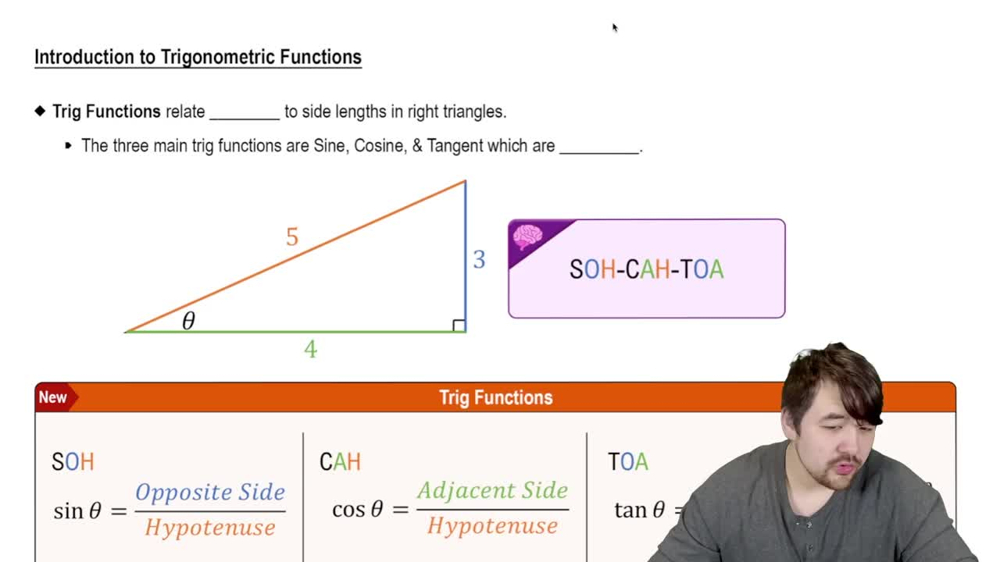
Determine which trigonometric ratios (sine, cosine, tangent) or identities are applicable based on the given information and what you need to find. Recall that for a right triangle, \(\sin \theta = \frac{\text{opposite}}{\text{hypotenuse}}\), \(\cos \theta = \frac{\text{adjacent}}{\text{hypotenuse}}\), and \(\tan \theta = \frac{\text{opposite}}{\text{adjacent}}\).
Set up equations using the appropriate trigonometric ratios or identities to express the unknown variables in terms of the known values.
Use algebraic methods to solve the equations for the unknown variables, ensuring to keep the expressions exact (in terms of square roots or fractions) rather than decimal approximations.
Verify your solutions by checking if the values satisfy the original triangle properties, such as the Pythagorean theorem or angle sum property, to ensure consistency and correctness.
Verified video answer for a similar problem:
This video solution was recommended by our tutors as helpful for the problem above
Video duration:
13m
Play a video:
0 Comments
Key Concepts
Here are the essential concepts you must grasp in order to answer the question correctly.
Trigonometric Ratios
Trigonometric ratios (sine, cosine, tangent) relate the angles of a right triangle to the ratios of its sides. Understanding these ratios is essential for finding unknown side lengths or angles when given partial information in a figure.
Solving triangles involves determining all unknown sides and angles using given information and trigonometric relationships. This process often requires applying laws such as the Law of Sines or Law of Cosines when the triangle is not right-angled.
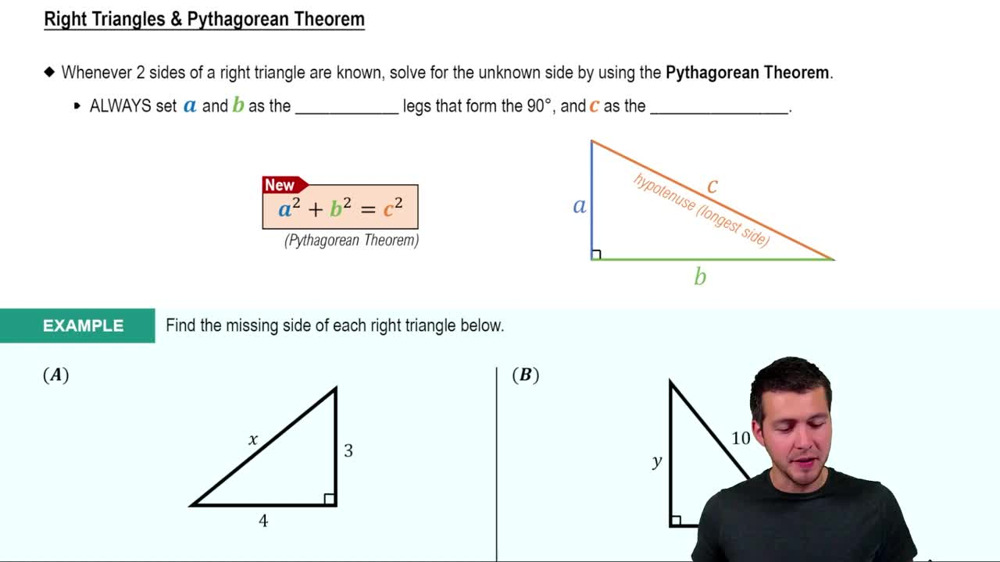
Solving Right Triangles with the Pythagorean Theorem
Exact Values of Special Angles
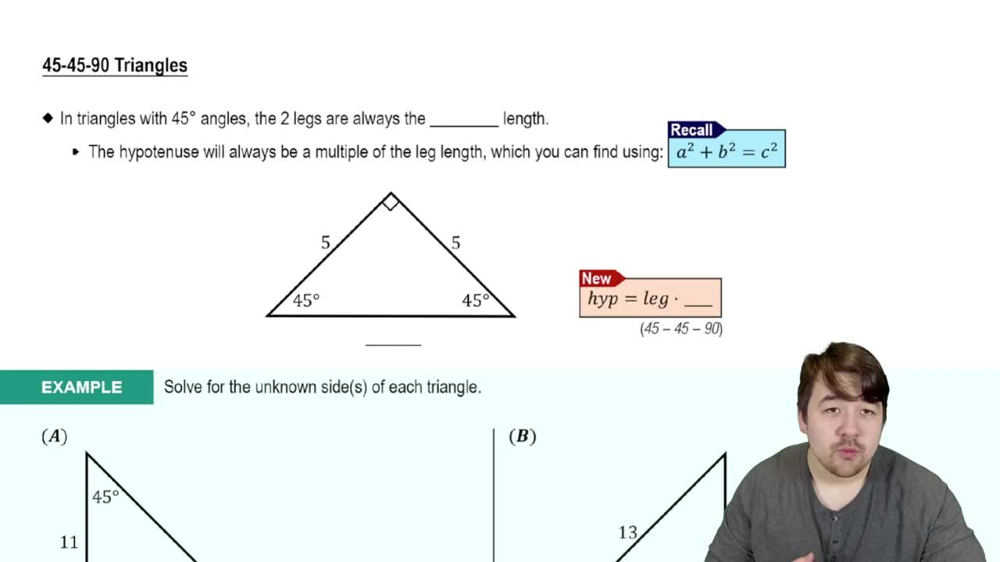
Exact values for sine, cosine, and tangent of special angles (30°, 45°, 60°) are commonly used to find precise answers without approximations. Memorizing these values helps in quickly solving problems involving standard geometric figures.

 13:29 minutes
 Verified step by step guidance
 6:04
6:04