If vectors and , determine the angle between vectors and .
Table of contents
- 0. Review of College Algebra4h 45m
- 1. Measuring Angles40m
- 2. Trigonometric Functions on Right Triangles2h 5m
- 3. Unit Circle1h 19m
- 4. Graphing Trigonometric Functions1h 19m
- 5. Inverse Trigonometric Functions and Basic Trigonometric Equations1h 41m
- 6. Trigonometric Identities and More Equations2h 34m
- 7. Non-Right Triangles1h 38m
- 8. Vectors2h 25m
- 9. Polar Equations2h 5m
- 10. Parametric Equations1h 6m
- 11. Graphing Complex Numbers1h 7m
8. Vectors
Dot Product
Problem 5
Textbook Question
In Exercises 1–8, use the given vectors to find v⋅w and v⋅v. v = -6i - 5j, w = -10i - 8j
Verified step by step guidance1
Identify the components of the vectors \( \mathbf{v} = -6\mathbf{i} - 5\mathbf{j} \) and \( \mathbf{w} = -10\mathbf{i} - 8\mathbf{j} \). Here, \( \mathbf{v} = (-6, -5) \) and \( \mathbf{w} = (-10, -8) \).
Recall the formula for the dot product of two vectors \( \mathbf{v} = (v_1, v_2) \) and \( \mathbf{w} = (w_1, w_2) \):
\[
\mathbf{v} \cdot \mathbf{w} = v_1 w_1 + v_2 w_2
\]
Calculate \( \mathbf{v} \cdot \mathbf{w} \) by multiplying the corresponding components and adding the results:
\[
(-6)(-10) + (-5)(-8)
\]
Recall that \( \mathbf{v} \cdot \mathbf{v} \) is the dot product of \( \mathbf{v} \) with itself, which gives the square of its magnitude. Use the formula:
\[
\mathbf{v} \cdot \mathbf{v} = v_1^2 + v_2^2
\]
Calculate \( \mathbf{v} \cdot \mathbf{v} \) by squaring each component of \( \mathbf{v} \) and adding them:
\[
(-6)^2 + (-5)^2
\]
Verified video answer for a similar problem:This video solution was recommended by our tutors as helpful for the problem above
Video duration:
3mPlay a video:
0 Comments
Key Concepts
Here are the essential concepts you must grasp in order to answer the question correctly.
Dot Product of Vectors
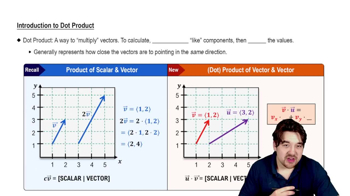
The dot product is an algebraic operation that takes two vectors and returns a scalar. It is calculated by multiplying corresponding components and summing the results, e.g., for vectors v = ai + bj and w = ci + dj, v⋅w = ac + bd. This operation measures the extent to which two vectors point in the same direction.
Recommended video:
Introduction to Dot Product
Vector Components and Notation
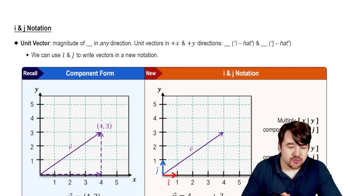
Vectors in two dimensions are expressed in terms of unit vectors i and j, representing the x and y directions respectively. Each vector is written as v = ai + bj, where a and b are scalar components along the x and y axes. Understanding this notation is essential for performing operations like the dot product.
Recommended video:
i & j Notation
Self Dot Product and Vector Magnitude
The dot product of a vector with itself, v⋅v, equals the sum of the squares of its components, which corresponds to the square of its magnitude (length). For v = ai + bj, v⋅v = a² + b². This concept is useful for finding the length of a vector or comparing vector sizes.
Recommended video:
Introduction to Dot Product
Related Videos
Related Practice
Multiple Choice
474
views