Find the absolute value of the radian measure of the angle that the second hand of a clock moves through in the given time. 55 seconds
Verified step by step guidance
1
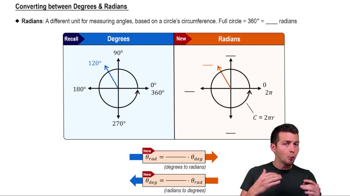
Recall that the second hand of a clock completes one full revolution (360 degrees or \(2\pi\) radians) in 60 seconds.
Determine the fraction of the full revolution the second hand moves through in 55 seconds by dividing 55 by 60, i.e., \(\frac{55}{60}\).
Multiply this fraction by the total radians in one full revolution to find the angle in radians: \(\frac{55}{60} \times 2\pi\).
Simplify the expression to get the radian measure of the angle moved by the second hand in 55 seconds.
Since the problem asks for the absolute value, ensure the final radian measure is positive (which it will be in this context).
Verified video answer for a similar problem:
This video solution was recommended by our tutors as helpful for the problem above
Video duration:
3m
Play a video:
0 Comments
Key Concepts
Here are the essential concepts you must grasp in order to answer the question correctly.
Radian Measure of Angles
Radian measure is a way to express angles based on the radius of a circle. One radian is the angle subtended by an arc equal in length to the radius. Since a full circle is 2π radians, radians provide a natural way to relate angles to arc lengths and circular motion.
The second hand of a clock completes one full rotation (2π radians) in 60 seconds. Its angular velocity is the rate of change of angle with respect to time, calculated as 2π radians divided by 60 seconds, which helps determine the angle moved in any given time interval.
To find the angle moved by the second hand in a given time, multiply the angular velocity by the time interval. This gives the radian measure of the angle traversed, which can be expressed as an absolute value since the question asks for the magnitude of the angle.

 3:15 minutes
 Verified step by step guidance
 5:04
5:04