Write each expression in terms of sine and cosine, and then simplify the expression so that no quotients appear and all functions are of θ only. See Example 3. [1 - sin²(-θ)]/[1 + cot²(-θ)]
Verified step by step guidance
1
Recall the Pythagorean identity: \(\sin^2(\theta) + \cos^2(\theta) = 1\). This will help simplify expressions involving \(1 - \sin^2(\theta)\).
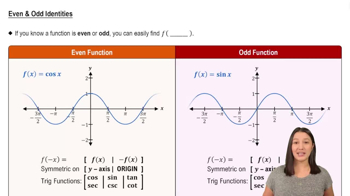
Rewrite the numerator \(1 - \sin^2(-\theta)\) using the identity. Since \(\sin(-\theta) = -\sin(\theta)\), we have \(\sin^2(-\theta) = \sin^2(\theta)\), so the numerator becomes \(1 - \sin^2(\theta)\).
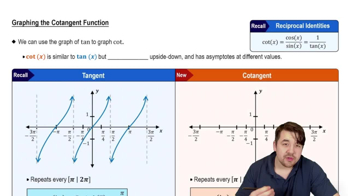
Rewrite the denominator \(1 + \cot^2(-\theta)\). Recall that \(\cot(\theta) = \frac{\cos(\theta)}{\sin(\theta)}\) and \(\cot(-\theta) = -\cot(\theta)\), so \(\cot^2(-\theta) = \cot^2(\theta)\). Use the Pythagorean identity \(1 + \cot^2(\theta) = \csc^2(\theta)\) to rewrite the denominator.
Express \(\csc(\theta)\) in terms of sine: \(\csc(\theta) = \frac{1}{\sin(\theta)}\), so \(\csc^2(\theta) = \frac{1}{\sin^2(\theta)}\). Substitute this into the denominator.
Combine the simplified numerator and denominator: \(\frac{1 - \sin^2(\theta)}{\frac{1}{\sin^2(\theta)}}\). Then rewrite \(1 - \sin^2(\theta)\) as \(\cos^2(\theta)\) and multiply by the reciprocal of the denominator to eliminate the fraction, resulting in an expression involving only sine and cosine with no quotients.
Verified video answer for a similar problem:
This video solution was recommended by our tutors as helpful for the problem above
Play a video:
0 Comments
Key Concepts
Here are the essential concepts you must grasp in order to answer the question correctly.
Pythagorean Identities
Pythagorean identities relate sine and cosine functions, such as sin²θ + cos²θ = 1. These identities allow rewriting expressions involving squares of sine or cosine in simpler forms, which is essential for simplifying trigonometric expressions without quotients.
Even-odd properties describe how trig functions behave under negation of the angle: sine and cotangent are odd functions (f(-θ) = -f(θ)), while cosine is even (f(-θ) = f(θ)). Recognizing these helps simplify expressions involving negative angles by rewriting them in terms of positive angles.
Cotangent is defined as cot θ = cos θ / sin θ. To eliminate quotients, cotangent expressions can be rewritten using sine and cosine, enabling simplification into forms involving only sine and cosine without fractions.

 Verified step by step guidance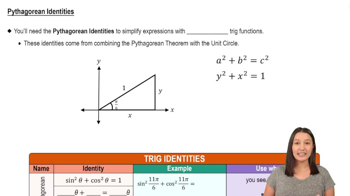
 6:25
6:25