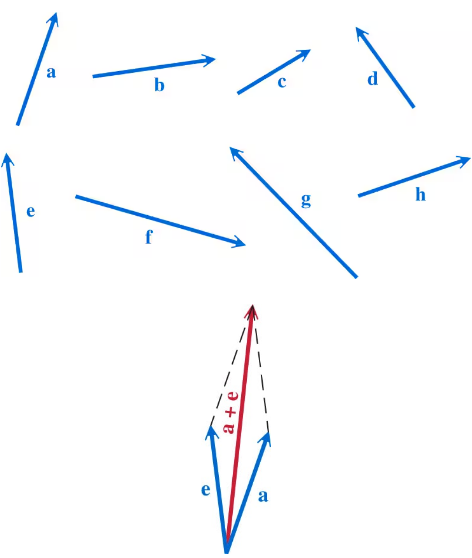
CONCEPT PREVIEW Refer to vectors a through h below. Make a copy or a sketch of each vector, and then draw a sketch to represent each of the following. For example, find a + e by placing a and e so that their initial points coincide. Then use the parallelogram rule to find the resultant, as shown in the figure on the right.
-b
Verified step by step guidance
1
Identify the vector \( \mathbf{b} \) from the given set of vectors. Understand its direction and magnitude based on the sketch or description provided.
To find \( -\mathbf{b} \), reverse the direction of vector \( \mathbf{b} \) while keeping its magnitude the same. This means if \( \mathbf{b} \) points in a certain direction, \( -\mathbf{b} \) points exactly opposite.
Draw the vector \( -\mathbf{b} \) starting from the origin or the same initial point as \( \mathbf{b} \), but pointing in the opposite direction.
Label the vector \( -\mathbf{b} \) clearly on your sketch to distinguish it from \( \mathbf{b} \).
Review your sketch to ensure that the length of \( -\mathbf{b} \) matches that of \( \mathbf{b} \) and that the direction is exactly reversed.
0 Comments
Key Concepts
Here are the essential concepts you must grasp in order to answer the question correctly.
Vector Addition and Subtraction
Vector addition involves combining two vectors by placing them head-to-tail and drawing the resultant vector from the start of the first to the end of the second. Subtraction, such as -b, means reversing the direction of vector b before adding it. Understanding how to add and subtract vectors graphically is essential for solving problems involving vector sums.
The parallelogram rule is a geometric method to find the resultant of two vectors originating from the same point. By placing the vectors tail-to-tail, you complete a parallelogram with these vectors as adjacent sides; the diagonal of this parallelogram represents their sum. This rule helps visualize vector addition and is crucial for accurate vector sketching.
A negative vector has the same magnitude as the original but points in the opposite direction. For example, -b is vector b reversed. Recognizing how to represent negative vectors graphically is important for correctly performing vector subtraction and understanding vector operations in trigonometry.

 Verified step by step guidance
 05:29
05:29