Solve each problem. See Example 5. Height of a Building A house is 15 ft tall. Its shadow is 40 ft long at the same time that the shadow of a nearby building is 300 ft long. Find the height of the building.
Table of contents
- 0. Review of College Algebra4h 45m
- 1. Measuring Angles40m
- 2. Trigonometric Functions on Right Triangles2h 5m
- 3. Unit Circle1h 19m
- 4. Graphing Trigonometric Functions1h 19m
- 5. Inverse Trigonometric Functions and Basic Trigonometric Equations1h 41m
- 6. Trigonometric Identities and More Equations2h 34m
- 7. Non-Right Triangles1h 38m
- 8. Vectors2h 25m
- 9. Polar Equations2h 5m
- 10. Parametric Equations1h 6m
- 11. Graphing Complex Numbers1h 7m
1. Measuring Angles
Complementary and Supplementary Angles
Problem 68
Textbook Question
In Exercises 67–68, an object is attached to a coiled spring. In Exercise 67, the object is pulled down (negative direction from the rest position) and then released. In Exercise 68, the object is propelled downward from its rest position. Write an equation for the distance of the object from its rest position after t seconds.
Verified step by step guidance1
Identify the type of motion described: since the object is attached to a coiled spring and moves up and down, this is simple harmonic motion, which can be modeled using sine or cosine functions.
Define the variables: let \(x(t)\) represent the distance from the rest position at time \(t\), \(A\) be the amplitude (maximum displacement), \(\omega\) be the angular frequency (related to the spring constant and mass), and \(\phi\) be the phase shift (which depends on initial conditions).
Write the general form of the equation for simple harmonic motion: \(x(t) = A \cos(\omega t + \phi)\) or \(x(t) = A \sin(\omega t + \phi)\).
For Exercise 67 (object pulled down and released), the initial displacement is maximum and velocity is zero, so use the cosine form with \(\phi = 0\), giving \(x(t) = -A \cos(\omega t)\) (negative because pulled down from rest).
For Exercise 68 (object propelled downward from rest position), the initial displacement is zero but initial velocity is downward, so use the sine form with appropriate phase shift, giving \(x(t) = -A \sin(\omega t)\).
Verified video answer for a similar problem:This video solution was recommended by our tutors as helpful for the problem above
Video duration:
4mPlay a video:
0 Comments
Key Concepts
Here are the essential concepts you must grasp in order to answer the question correctly.
Simple Harmonic Motion (SHM)
Simple Harmonic Motion describes oscillatory motion where the restoring force is proportional to displacement and acts in the opposite direction. For a mass-spring system, the motion is sinusoidal, and the position varies with time as a sine or cosine function, representing periodic movement about the rest position.
Recommended video:
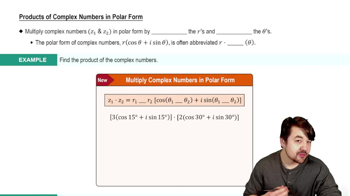
Products of Complex Numbers in Polar Form
Trigonometric Functions in Oscillations
Sine and cosine functions model the displacement of oscillating objects over time. The choice between sine or cosine depends on initial conditions, such as starting position or velocity. These functions capture the periodic nature of the motion with parameters for amplitude, frequency, and phase shift.
Recommended video:
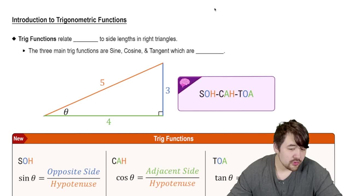
Introduction to Trigonometric Functions
Initial Conditions and Phase Shift
Initial conditions like initial displacement and velocity determine the phase shift and amplitude in the trigonometric equation of motion. For example, pulling the object down corresponds to a nonzero initial displacement, while propelling it downward from rest position corresponds to an initial velocity, affecting the form of the solution.
Recommended video:
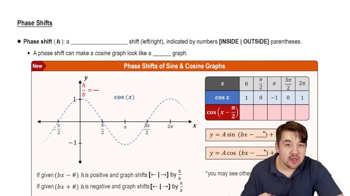
Phase Shifts
Related Videos
Related Practice
Textbook Question
662
views