For each expression in Column I, use an identity to choose an expression from Column II with the same value. Choices may be used once, more than once, or not at all. -sin 35°
Verified step by step guidance
1
Recognize that the expression is \(-\sin 35^\circ\), which is the negative of the sine of 35 degrees.
Recall the identity for sine of a negative angle: \(\sin(-\theta) = -\sin \theta\). This means \(-\sin 35^\circ = \sin(-35^\circ)\).
Also remember the sine co-function identity: \(\sin(180^\circ - \theta) = \sin \theta\). Using this, \(-\sin 35^\circ = \sin(-35^\circ) = \sin(360^\circ - 35^\circ) = \sin 325^\circ\).
Alternatively, use the identity \(\sin(\theta) = -\sin(180^\circ - \theta)\) to rewrite \(-\sin 35^\circ = \sin(180^\circ - 35^\circ) = \sin 145^\circ\).
Therefore, expressions like \(\sin(-35^\circ)\), \(\sin 325^\circ\), or \(\sin 145^\circ\) are equivalent to \(-\sin 35^\circ\) and can be matched accordingly.
Verified video answer for a similar problem:
This video solution was recommended by our tutors as helpful for the problem above
Play a video:
0 Comments
Key Concepts
Here are the essential concepts you must grasp in order to answer the question correctly.
Trigonometric Identities
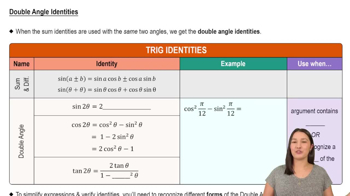
Trigonometric identities are equations involving trigonometric functions that hold true for all angle values. They allow the transformation of expressions into equivalent forms, such as converting sine to cosine or using negative angle identities to simplify or match expressions.
Negative angle identities relate the trigonometric function of a negative angle to that of a positive angle. For sine, sin(-θ) = -sin(θ), which means -sin(35°) can be rewritten as sin(-35°), helping to find equivalent expressions.
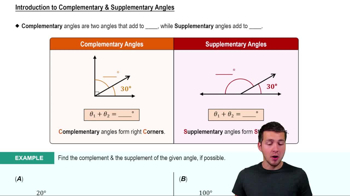
Sine and cosine functions have relationships based on complementary (90° - θ) and supplementary (180° - θ) angles. For example, sin(θ) = cos(90° - θ), and these relationships help in matching expressions by rewriting angles in different forms.