In Exercises 47–52, write the vector v in terms of i and j whose magnitude ||v|| and direction angle θ are given. ||v|| = 1/2, θ = 113°
Verified step by step guidance
1
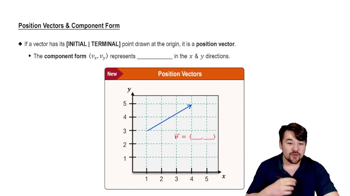
Recall that a vector \( \mathbf{v} \) in the plane can be expressed in terms of the unit vectors \( \mathbf{i} \) and \( \mathbf{j} \) as \( \mathbf{v} = v_x \mathbf{i} + v_y \mathbf{j} \), where \( v_x \) and \( v_y \) are the components of \( \mathbf{v} \) along the x- and y-axes respectively.
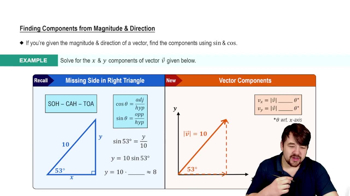
Use the magnitude \( ||\mathbf{v}|| \) and the direction angle \( \theta \) to find the components of \( \mathbf{v} \). The formulas for the components are:
\[ v_x = ||\mathbf{v}|| \cos(\theta) \]
\[ v_y = ||\mathbf{v}|| \sin(\theta) \]
Substitute the given values \( ||\mathbf{v}|| = \frac{1}{2} \) and \( \theta = 113^\circ \) into the component formulas:
\[ v_x = \frac{1}{2} \cos(113^\circ) \]
\[ v_y = \frac{1}{2} \sin(113^\circ) \]
Write the vector \( \mathbf{v} \) in terms of \( \mathbf{i} \) and \( \mathbf{j} \) using the components found:
\[ \mathbf{v} = v_x \mathbf{i} + v_y \mathbf{j} \]
Remember that the cosine and sine of angles greater than 90° will be positive or negative depending on the quadrant, so consider the sign of each component based on the angle \( 113^\circ \) which lies in the second quadrant.
Verified video answer for a similar problem:
This video solution was recommended by our tutors as helpful for the problem above
Video duration:
2m
Play a video:
0 Comments
Key Concepts
Here are the essential concepts you must grasp in order to answer the question correctly.
Vector Representation in the Plane
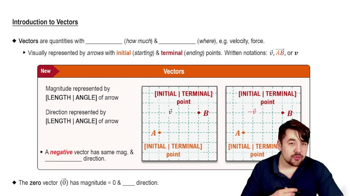
A vector in two dimensions can be expressed as a combination of unit vectors i and j along the x- and y-axes, respectively. Writing a vector in terms of i and j involves finding its horizontal (x) and vertical (y) components based on its magnitude and direction.
The magnitude of a vector represents its length, while the direction angle θ is the angle it makes with the positive x-axis, measured counterclockwise. These two parameters uniquely define the vector's position in the plane.
The x-component of a vector is found by multiplying its magnitude by cos(θ), and the y-component by multiplying the magnitude by sin(θ). This uses basic trigonometric functions to convert polar form (magnitude and angle) into rectangular form (i and j components).